
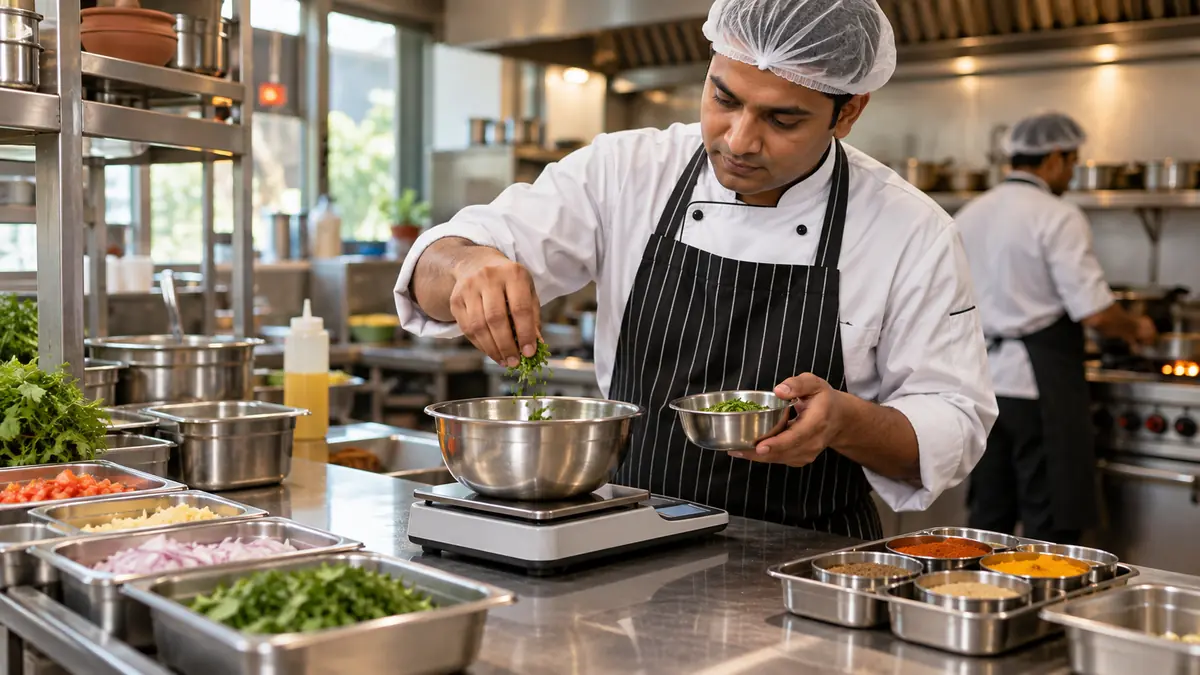
Food cost is one of the clearest signals of whether a restaurant is converting sales into a healthy gross margin. It is also one of the easiest numbers to misunderstand. A restaurant can have strong sales and still lose margin through over-portioning, yield loss, purchase variance, wastage, unrecorded consumption or menu prices that do not reflect the recipe cost.
What restaurant food cost means
Restaurant food cost is the cost of the ingredients consumed to produce the food sold during a period, expressed as a percentage of food sales. It should be read alongside sales mix, discounts, complimentary items, wastage, staff meals and the operating model.
Food cost is not just the invoice value of ingredients purchased. Purchases become part of food consumed only after opening and closing inventory are taken into account.
Theoretical vs actual food cost
Theoretical food cost is what the restaurant should have consumed according to standard recipes, standard portions, the sales mix and the recorded number of items sold.
Actual food cost is what the restaurant appears to have consumed after comparing opening inventory, purchases and closing inventory with food sales.
The gap between the two is often the most useful management signal. It can point to over-portioning, recipe deviation, waste, pilferage, receiving errors, incorrect sales mapping, unrecorded staff meals or a stock-count problem. The gap is a prompt to investigate; it should not be treated as a conclusion by itself.
How to Calculate Actual Restaurant Food Cost
Use the inventory movement for the same accounting period as the sales. Ideally, opening and closing stock are counted using the same units, categories and valuation method.
| Step | Calculation | What to check |
|---|---|---|
| 1. Food consumed | Opening Inventory + Purchases − Closing Inventory | All three inventory values cover the same food categories and period. |
| 2. Food cost % | Food Consumed ÷ Food Sales × 100 | Food sales are separated from taxes, delivery fees and non-food revenue. |
For example, if opening inventory is ₹2,00,000, purchases are ₹6,00,000 and closing inventory is ₹1,50,000, food consumed is ₹6,50,000. If food sales are ₹20,00,000, the actual food cost is 32.5%.
PRACTICAL TOOL
Restaurant Food Cost Calculator
Enter the figures for one consistent period. Use the same valuation approach for opening and closing inventory.
Enter your figures to calculate actual food cost.
Compare your actual food cost with theoretical food cost based on standard recipes and sales mix. The result is a measurement for investigation and control; it is not automatically good, bad, high or low.
The key drivers of restaurant food cost
Recipe costing and standardisation
Every important menu item should have a standard recipe with ingredients, purchase units, yields, portion size, garnish, cooking loss and recipe cost. Without this foundation, theoretical food cost cannot be calculated reliably.
Yield
Yield is the usable quantity left after trimming, cleaning, cooking or processing. A purchase price that looks low can become expensive when the usable yield is poor. Record usable yield for proteins, produce, sauces, gravies, doughs and other high-value preparations.
Portion control
Portion control connects the recipe to the plate or pack. Use calibrated ladles, scales, scoops, serving tools, portion cards and regular checks. Small deviations repeated across hundreds of covers can materially change food cost.
Purchasing and receiving
Approved specifications, vendor comparisons, purchase rates, receiving checks and invoice matching protect the cost base. Check weight, quality, temperature, pack size and substitutions at receiving rather than discovering the variance during month-end analysis.
Wastage and unrecorded consumption
Track prep waste, spoilage, expired stock, returns, production overage, complimentary items, staff meals and damaged goods. A simple reason-coded waste log is more useful than a single unexplained percentage.
Inventory discipline
Count high-value and fast-moving items frequently. Keep storage organised, label dates, follow FIFO or FEFO where appropriate, and investigate negative stock, unusual transfers and large variances between physical and system stock.
Account for aggregator economics
Food cost is only one part of the contribution calculation for delivery orders. Commission, platform-funded discounts, advertising, packaging, refunds, remakes and taxes can materially affect what the restaurant retains from the listed price.
Review menu performance by channel rather than assuming that a popular item has the same economics everywhere. A recipe and price that work in the dining room may need a different pack, portion, bundle or price for delivery.
Use technology to make control consistent
POS, recipe-costing tools, inventory systems, purchase records, kitchen display systems and daily dashboards can reduce manual gaps when their master data is maintained. Technology does not replace a count, a standard recipe or a manager review; it makes the evidence easier to capture and compare.
At a minimum, the operating team should be able to see sales, purchases, stock, waste, theoretical food cost, actual food cost and the variance by period and outlet.
Build a repeatable food-cost control cycle
- Standardise: maintain recipes, yields, portions, prices and selling units.
- Plan: forecast sales, production and purchasing around the menu mix.
- Receive: check quantity, quality, temperature, price and substitutions.
- Store: label, rotate and count stock using defined controls.
- Produce: follow batch sheets, portion tools and waste recording.
- Review: compare theoretical and actual food cost at a useful frequency.
- Correct: assign an owner, action and follow-up date for each variance.
The purpose of the cycle is not to chase one perfect percentage. It is to understand what is happening, act on the cause and make the next period more controlled.
See where a busy restaurant’s money usually leaks, with a quick check for each.
Ready to improve your restaurant economics?
Share your format, city and current challenge with Restavision.
Book a free call