
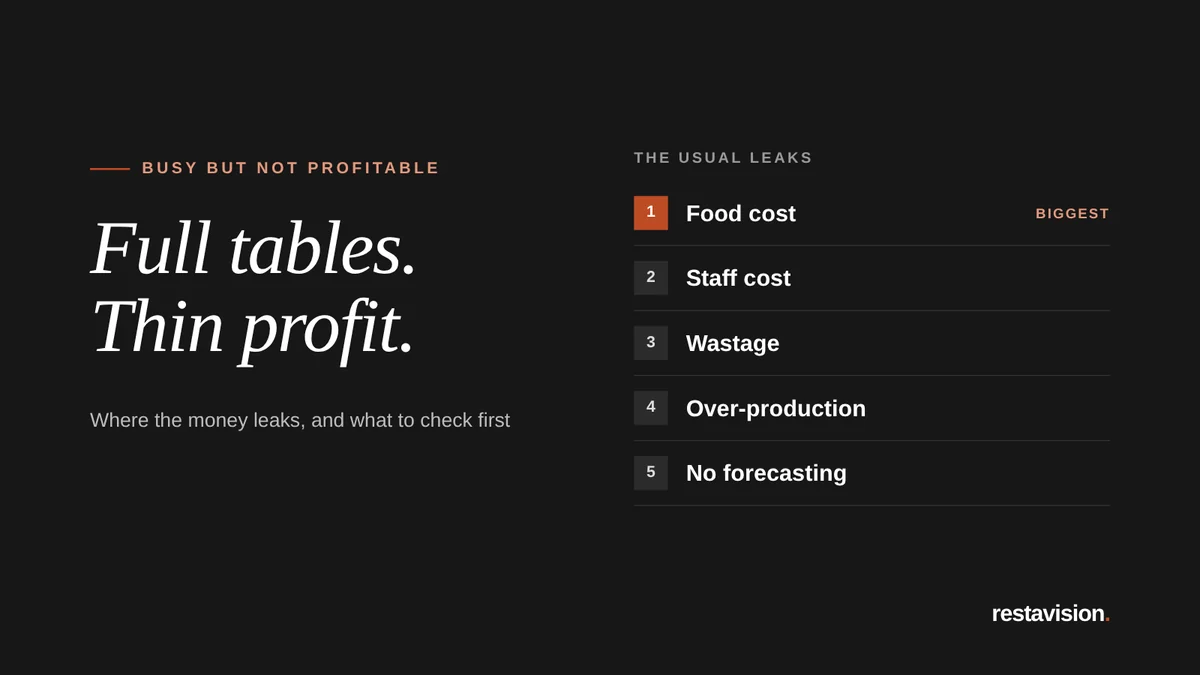
A full restaurant that makes no money almost never has a sales problem. It has a cost problem that sales are hiding. When tables turn every night, owners assume the money will follow. When it doesn’t, the first instinct is to push sales harder: more offers, more delivery, longer hours. That usually makes the leak bigger, because every extra order carries the same loss. In our experience, the money leaks from the same few places, in roughly this order.
Where the money leaks
| Where money leaks | Quick check |
|---|---|
| Food cost | Is your actual food cost close to what your recipe costing says it should be? |
| Staff cost | Do you have more people on shift than the covers need, or pay above what the role delivers? |
| Wastage | Is anyone writing down what gets thrown away, every day? |
| Over-production | Does the kitchen prep the same quantity every day, whatever the day? |
| No forecasting | Can you say how many covers to expect next Saturday? |
| Delivery margins | Do you know what you keep from a ₹500 delivery order after commission and discounts? |
Where we look first
Before opening a single invoice, we check three things. Together they tell you whether the problem is in the kitchen, on the menu or with the guest.
- Product pricing. Is each dish priced on what it actually costs to make today, or on what it cost when the menu was printed? Ingredient prices move; menu prices often don’t.
- Quality of the food. Is the plate the guest gets the plate the recipe describes? Portions that drift bigger cost money. Quality that drifts lower costs repeat guests.
- Customer feedback. What are guests saying in reviews and at the table? Complaints about portion, taste or value often point straight at a pricing or recipe problem.
If pricing is out of date, quality is inconsistent and feedback is slipping, start with food cost. If all three look healthy, look harder at staff cost and wastage.
1. Food cost: the biggest leak
In our experience, food cost is the most common reason a busy outlet loses money. It rarely shows up as one big mistake. It is many small ones: a dish priced years ago, a supplier rate that crept up, a heavier hand on the expensive ingredient, a bestseller that turns out to be your lowest-margin dish.
Quick check: work out your actual food cost for last month (opening stock + purchases − closing stock, divided by food sales) and compare it with what your recipe costing says it should be. A big gap means money is leaking between the store room and the plate.
We worked with a famous restaurant in Mumbai that had great sales but was still not making money. The main reason was food cost. Just by correcting the menu and the menu costing, food cost came down from 40% to 32% of food sales. That is ₹8 more kept from every ₹100 of food sold, with no rise in sales needed. The money was already coming in; it just wasn’t staying.
Go deeper: how to calculate and control food cost, and menu engineering to find which dishes earn and which ones only sell.
2. Staff cost: too many people, or paid wrongly
A busy outlet often adds people to cope with the rush, and never takes them away when the rush ends. The other version is pay that has drifted above what the role delivers.
Quick check: put your staff rota next to your hourly sales for one week. Count how many people are on the floor and in the kitchen during your slowest two hours. Then list each role, its pay and what it is responsible for.
Fix: roster to the covers you expect, not the covers you fear. Write down what each role does, so pay follows responsibility. Clear restaurant SOPs make this much easier.
3. Wastage
Wastage is money in the bin that never appears on the P&L as its own line. It hides inside food cost.
Quick check: keep a simple wastage sheet in the kitchen for seven days: item, quantity, reason (spoiled, over-prepped, returned, dropped). Most owners are surprised by the total.
4. Over-production
Prepping the same quantity every day, whatever the day, guarantees waste on quiet days and shortages on busy ones. Over-prepped gravies, cut vegetables and marinated proteins either get thrown away or get used past their best, which then shows up in quality and reviews.
Quick check: compare what the kitchen prepped with what actually sold, item by item, for three different days of the week.
5. No forecasting
Over-production and over-staffing both start here. Without a forecast, purchase, prep and rota are guesses.
Fix: forecasting doesn’t need software to start. Use the same day last week and the same day last month, adjust for festivals, events and weather, and set prep and staffing from that number. Review it every week.
Also check delivery. If a large share of your sales comes through aggregators, commission and discounts can quietly eat the margin on every order. See Swiggy & Zomato commission: how to protect your delivery margins.
A one-week money-leak check
You can run this yourself, starting Monday:
- Day 1: work out last month’s actual food cost % and compare it with your recipe costing.
- Day 2: check the menu prices of your 10 best-selling dishes against what they cost to make today.
- Day 3: put the staff rota next to hourly sales and mark the slow hours.
- Days 1–7: keep a wastage sheet in the kitchen.
- Three different days: compare prep quantities with what actually sold.
- Day 7: read the last month of reviews and note every comment on portion, taste or value.
By the end of the week you’ll know which leak is biggest, and that is where to start.
Common questions
My restaurant is always full. How can it not be making money?
Because full tables tell you about sales, not about what each sale costs. If food, staff and wastage take too much of every bill, more guests only means more of the same loss.
Should I raise prices?
Only after you know which dishes are underpriced. A blanket increase can push guests away from dishes that were already profitable. Menu engineering shows you which prices to change.
Should I cut staff?
Roster to your forecast first. Cutting people without a forecast often shows up as slower service and worse reviews on your busiest days.
How quickly can this be fixed?
Pricing and recipe fixes can show up in the next month’s numbers. Staffing and forecasting take a few weeks of discipline to settle.
Full tables, thin profit?
Tell us your format, monthly sales and where you think the money is going, and we’ll tell you where we’d look first.
Book a free call