Restaurant hygiene is not a one-time inspection exercise. It is a daily operating discipline that protects guests, staff, the brand and the business. In India, food businesses must understand and follow applicable Food Safety and Standards Authority of India (FSSAI) requirements, local permissions and the controls relevant to their format and operations.
Why restaurant hygiene controls matter
Food safety failures can lead to illness, complaints, product loss, regulatory action, reputational damage and avoidable operating disruption. Strong hygiene systems reduce risk by making the correct action clear at the point where food is received, stored, prepared, cooked, held, packed and served.
A useful system is practical enough for a busy shift. It defines the standard, assigns responsibility, records evidence and makes it possible for a manager to correct a gap before it becomes a customer issue.
Food handling and storage controls
Receive with a clear specification
Receiving is the first control point. Check supplier, quantity, packaging condition, use-by or best-before information, product temperature where relevant, signs of contamination and any substitution against the approved purchase specification. Record rejections and corrective action.
Separate raw, cooked and ready-to-eat food
Use defined storage zones, colour-coded equipment where appropriate and clear labelling. Keep raw materials away from cooked and ready-to-eat food, and prevent cross-contamination through hands, utensils, containers, surfaces and storage drips.
Label, date and rotate
Every prepared item should be identifiable with product name, preparation date or time, use-by information and responsible area. Follow FIFO or FEFO where appropriate, and remove expired or unidentified food immediately.
Protect food during preparation and service
Keep food covered when practical, use clean utensils, minimise unnecessary hand contact and maintain separation between food, chemicals, waste and personal belongings. The same discipline should apply to dine-in, takeaway and delivery dispatch.
Temperature control is a daily control, not a single reading
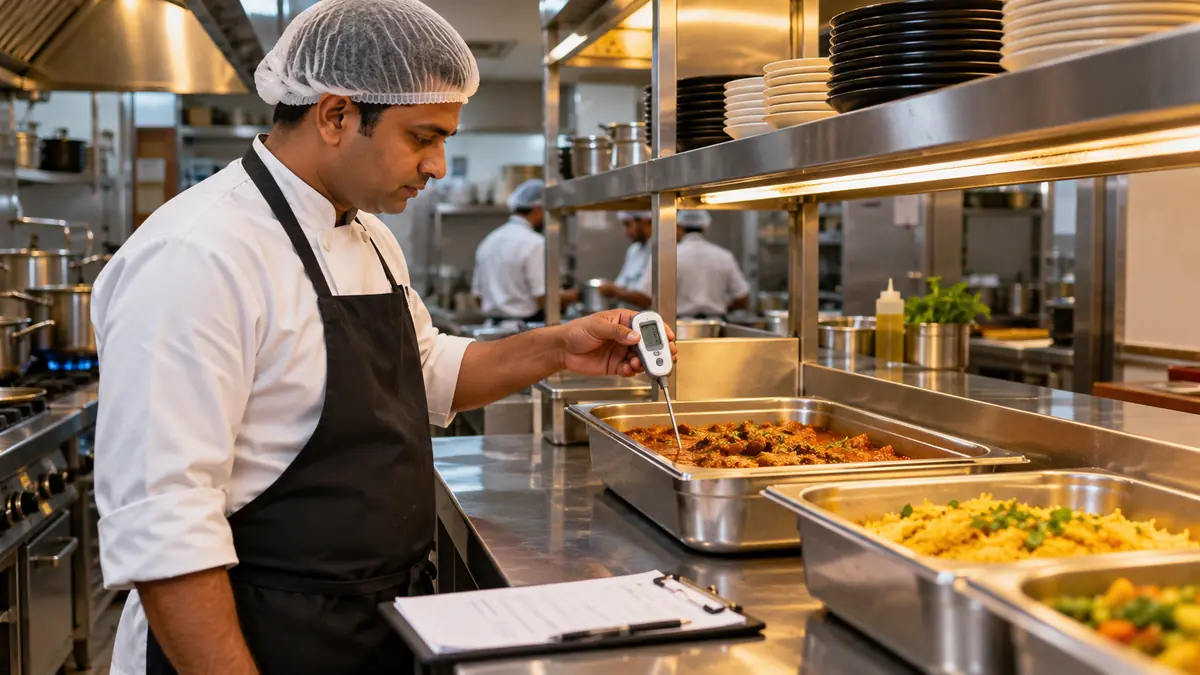
Temperature checks should be tied to the food journey: receiving, chilled and frozen storage, cooking, hot holding, cooling, reheating, display and dispatch. Record the measurement, time, equipment or item checked and the action taken when a result falls outside the defined operating limit.
| Control point | What to verify |
|---|---|
| Receiving | Is the delivery within the business’s approved specification and safe receiving process? |
| Cold storage | Are chillers and freezers operating, organised, labelled and not overloaded? |
| Cooking | Are required foods cooked according to the approved process and verified where applicable? |
| Holding and display | Is the holding time controlled and is food protected from contamination? |
| Cooling and reheating | Are approved time-temperature processes followed and recorded for relevant preparations? |
Do not rely on memory. Use calibrated or verified devices, record readings consistently and define what the team must do when a reading is outside the operating standard.
Cleaning, sanitation and personal hygiene
Clean before you sanitise
Cleaning removes food residue, grease and soil. Sanitising is a separate step. Use the right chemical, dilution, contact time, tool and storage method for each area, and keep chemical containers labelled and away from food.
Make high-touch points visible
Door handles, refrigerator handles, taps, switches, telephones, order screens and service equipment need defined frequencies and ownership. A simple cleaning schedule should show what is cleaned, by whom, when and how it is verified.
Set a personal-hygiene standard
Define handwashing moments, clean uniforms or protective clothing, hair restraint, illness reporting, glove use where applicable, jewellery restrictions and the process for managing cuts or wounds. Supervisors should observe and coach the standard during operations.
Control pests and waste
Keep waste containers covered where required, remove waste on schedule, maintain clean refuse areas and record pest sightings or contractor actions. A clean kitchen with an unmanaged waste route is not a complete hygiene system.
Daily Restaurant Hygiene Checklist
The checklist below is an operating aid for shift teams and managers. Adapt the frequency, limits, responsibilities and evidence to the restaurant format and applicable requirements.
Opening checks
- Check that the kitchen, service, storage and receiving areas are clean, dry and free from visible contamination.
- Verify chillers, freezers, hot-holding equipment, thermometers and other relevant equipment are working.
- Review opening temperature readings and record any corrective action.
- Check raw, cooked and ready-to-eat storage separation, labels, dates and product condition.
- Confirm handwash stations have water, soap, drying provision and required signage.
- Check food-contact surfaces, utensils, chopping boards and small equipment are clean and ready for use.
- Verify staff hygiene, uniforms, hair restraints and fitness to work before food handling begins.
- Check cleaning chemicals are labelled, stored safely and separate from food and packaging.
- Confirm pest-control signs, waste areas and drains are acceptable before opening.
During-operation checks
- Observe handwashing and prevention of cross-contamination during preparation and service.
- Record required chilled, frozen, cooking, holding, cooling or reheating checks at the defined frequency.
- Maintain food covers, clean utensils, service protection and separation of raw and cooked items.
- Check preparation labels, use-by times, batch control and rotation throughout the shift.
- Record spills, breakages, expired food, rejected deliveries, waste and corrective actions.
- Keep work surfaces, floors, sinks, handles and high-touch points clean during peak operations.
- Check staff meals, samples, complimentary items and returns are handled and recorded correctly.
- Review delivery packing, dispatch hygiene and protection of food until handover.
- Escalate equipment failure, pest activity, illness or any food-safety concern to the manager immediately.
Closing checks
- Discard or retain prepared food only according to the approved process and recorded use-by controls.
- Complete final stock, label, storage and segregation checks; remove expired or unidentified food.
- Clean and sanitise food-contact surfaces, equipment, utensils, floors, drains and waste areas.
- Empty waste safely, clean bins and leave waste routes ready for the next shift.
- Record closing temperatures and any equipment or refrigeration issue requiring follow-up.
- Confirm chemicals, tools and personal belongings are stored away from food and preparation areas.
- Review open corrective actions, assign an owner and record the next check or completion time.
- Manager signs off the completed checklist and escalates any unresolved safety risk before the next opening.
Training and audits make the checklist useful
A checklist cannot create food safety on its own. Train the team on the reason behind each control, demonstrate the correct method, observe execution and review records. Use short shift briefings for recurring issues and refresh training when there is a menu, process, equipment, team or regulatory change.
Audits should look for evidence, not just completed ticks. Review photographs or records where relevant, speak to the person performing the task, inspect the condition on the floor and record a corrective action with an owner and due date.
For restaurants that need structured operating systems, Restaurant Operations & SOP Consulting can connect hygiene standards with SOPs, training, checklists, audits and manager reviews.
From Paper Checklist to Digital Food-Safety Control
Paper checklists can be a useful starting point, but digital operating controls can make follow-up, evidence and management visibility more consistent across shifts and locations. Restavision’s technology direction is to support practical restaurant operations through:
These capabilities describe Restavision’s digital operating direction and technology capability. They should not be read as a claim that a fully launched software product is available today. The objective is to help restaurant teams move from a completed form to a visible, reviewable operating record.
A future-ready workflow can allow a team member to complete a mobile check, attach evidence, record a corrective action, assign ownership and give a manager a historical view by outlet, date or checklist type.
Build food safety into restaurant ownership
Food safety is strongest when it is owned by the operation, not left only to an auditor. The owner or manager should know the critical control points, review exceptions, allocate time for cleaning and training, and close corrective actions. Each shift should know what must be checked before opening, during service and at closing.
For a new restaurant, hygiene should be designed into the layout, equipment plan, storage, production flow, staff training and opening readiness from the start. Restaurant Setup Consulting can help connect these requirements to the broader setup and launch plan.
Ready to strengthen your restaurant operations?
Share your format, city and current challenge with Restavision.
Book a free call