
Before guests try a new restaurant, most of them look at its rating and read a few recent reviews. A drop from 4.4 to 3.9 can quietly cost covers and delivery orders, often without the owner noticing until sales fall. The good news is that ratings are not luck. They follow the guest experience, and they respond to a simple, consistent routine: fix the causes, ask every guest for honest feedback, reply to every review and track the numbers every week.
Why ratings matter more than ever
BrightLocal's 2026 survey of local consumers gives a clear picture of how people use reviews. The sample was US consumers, but the same habits are visible wherever guests choose restaurants on Google Maps and delivery apps.
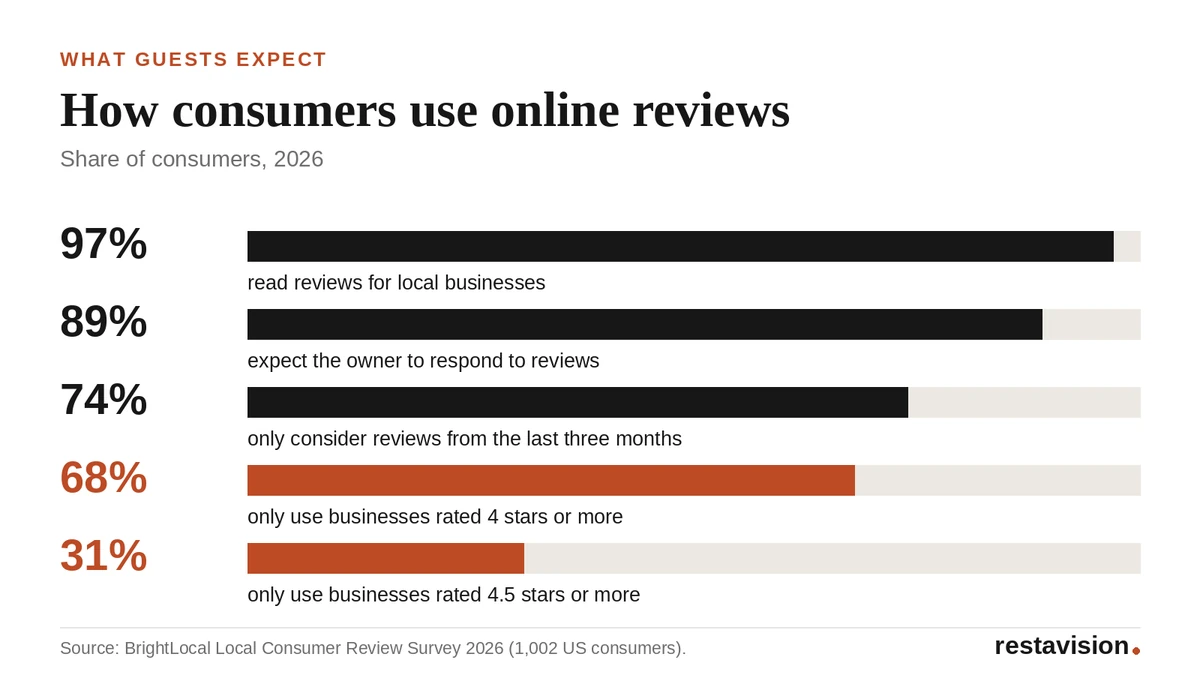
Two findings stand out for restaurants. First, recency matters: most people only consider reviews from the last three months, so last year's praise does little for you today. Second, the bar is rising: in the survey, the share of consumers who will only use a business rated 4.5 stars or higher almost doubled from the year before. Google also uses review count and rating as part of how prominently a business appears in local results.
Know where your guests review you
Most restaurants collect reviews in more places than they monitor. List every platform that matters for your outlet and check them on a fixed schedule.
- Google Business Profile: often the first thing a guest sees when searching for your name or "restaurants near me".
- Zomato: separate dining and delivery ratings, both visible to guests.
- Swiggy and other delivery apps: ratings that affect how guests see and choose you in the app.
- Travel and social platforms: TripAdvisor, Instagram comments and tags, and local food groups, depending on your guests.
Keep the profile on each platform accurate: opening hours, phone number, menu, prices and recent photos. Wrong hours or an outdated menu create disappointed guests and avoidable bad reviews.
Fix what causes bad reviews
Replies and review requests help, but ratings improve for good only when the experience improves. Read the last three months of reviews across platforms and sort every complaint into a theme. Usually a few themes cause most of the damage.
| Complaint theme | Usual cause | Operational fix |
|---|---|---|
| Taste or quality varies | Recipes not followed; untrained or rotating cooks | Standard recipes, portion tools and taste checks at the pass |
| Long waits | Understaffed peaks; slow kitchen flow | Peak-hour rosters, prep lists and a kitchen ticket time target |
| Rude or slow service | Unclear service steps; tired or poorly briefed staff | Service SOPs, pre-shift briefings and coaching |
| Cleanliness | No fixed cleaning routine or checks | Cleaning schedules and daily hygiene checklists with sign-off |
| Wrong or missing items | No order check before dispatch | Order-check step against the ticket before sealing |
| Cold or soggy delivery | Packaging or menu items not suited to travel | Better packaging and a delivery-friendly menu |
| Poor value | Portions or prices out of line with expectations | Review portions, pricing and menu descriptions |
Share the top two themes with the team every week, decide one fix for each and check whether those complaints fall over the next month. Our guide to restaurant SOPs covers the routines that keep the experience consistent.
Ask for reviews the right way
Many happy guests never leave a review simply because nobody asked. A steady flow of honest, recent reviews is the best protection against a few bad ones. The way you ask matters, because platforms penalise manipulation.
Good ways to ask
- A QR code on the bill folder, table tent or receipt that opens your Google review page.
- A short WhatsApp or SMS thank-you after a booking or an order, with a review link.
- A card in delivery bags inviting honest feedback.
- Staff mentioning, politely and without pressure, that honest reviews help the restaurant.
Use neutral wording such as "We would appreciate your honest feedback on Google", and send the request to every guest, not only the ones you expect to be happy.
What to avoid
- Offering discounts, free items or any reward in exchange for a review.
- Asking only satisfied guests, or filtering unhappy guests to a private form first.
- Giving staff review targets or asking guests to name a staff member.
- Reviews from owners, staff, family, vendors or paid services.
- Pressing guests to write a review while they are still at the table.
Google's review policies prohibit these practices, and its April 2026 update spelled several of them out. Breaking the rules can lead to reviews being removed or a warning shown on your profile, which does far more harm than a few honest complaints.
Respond to every review, quickly and personally
Replies are read by future guests as much as by the reviewer. They show that someone cares and that problems get fixed. Aim to reply within a day, and use the guest's points rather than a copy-pasted template.
For a positive review
Thank the guest by name, mention something specific they enjoyed and invite them back. Keep it short.
For a negative review
- Thank: thank the guest for taking the time to write.
- Acknowledge: name the specific problem without excuses or argument.
- Apologise: apologise sincerely for that experience.
- Explain the fix: say briefly what you have changed or are checking.
- Take it offline: give a phone number or WhatsApp contact to resolve it directly.
Never argue publicly, share a guest's personal details or offer compensation in exchange for changing a review. If a review is fake, abusive or about a different business, report it through the platform's own process instead of replying in anger.
Protect your delivery ratings
Delivery guests judge the food after it has travelled, often without any contact with your team. Their ratings depend on things the kitchen controls before the rider arrives:
- packaging that keeps food hot, crisp and sealed;
- an order check so nothing is missing or wrong;
- realistic preparation times, especially at peak hours;
- menu photos and descriptions that match what arrives;
- switching off items or the outlet when the kitchen cannot keep up.
Our guide to delivery app commissions and margins covers how complaints and refunds also cut into delivery profit.
Track the right numbers every week
| Measure | What it tells you |
|---|---|
| Average rating by platform | Whether guests' overall view is improving or slipping. |
| New reviews this week | Whether your review requests are working and your profile stays recent. |
| Share of 1–2 star reviews | How often the experience goes badly wrong. |
| Response rate and time | Whether every review gets a timely, personal reply. |
| Top complaint themes | Which operational fixes to prioritise next. |
A weekly review routine
- Check: read new reviews on every platform at least once a day, and in full once a week.
- Reply: respond to every review within a day, starting with the negative ones.
- Sort: tag each complaint by theme and outlet.
- Fix: agree one operational fix for each of the top two themes.
- Brief: share good reviews and lessons with the team at the pre-shift meeting.
- Ask: keep QR codes, receipts, follow-up messages and bag cards in use.
- Measure: update the scorecard and compare it with the previous month.
A strong rating is the visible result of a consistent restaurant. Treat reviews as free daily feedback on your operation, and the rating will follow.
Ready to improve your ratings?
Share your format, city and current rating challenge with Restavision.
Book a free call