
For many restaurants, delivery apps bring a large share of orders, but not always a fair share of profit. Commission is only the start. Platform-run discounts, advertising, payment and service fees, GST on those fees and deductions after complaints all come out of the payout. A restaurant can grow its online sales and still make less money. The answer is not to leave the platforms in a hurry. It is to know what each order really earns and to manage delivery as its own business.
Why delivery margins are under pressure
In July and August 2026, restaurant associations in Bengaluru threatened to stop taking orders from Swiggy and Zomato. Their complaints were specific: discounts and promotional campaigns run without the restaurant's consent, unclear deductions, money cut after customer complaints, and losses on orders cancelled after the food was cooked. Restaurant owners quoted in the press described commissions of roughly 20–30% per order and said that, after discounts and other charges, they could be left with ₹40–60 of every ₹100.
After talks, both platforms were reported to have agreed to seek a restaurant's consent before running restaurant-funded promotions. That is a useful step, but it does not fix the economics of an individual outlet. Every restaurant still needs to read its own statements, choose its own campaigns and price its own delivery menu.
Work out what one delivery order really earns
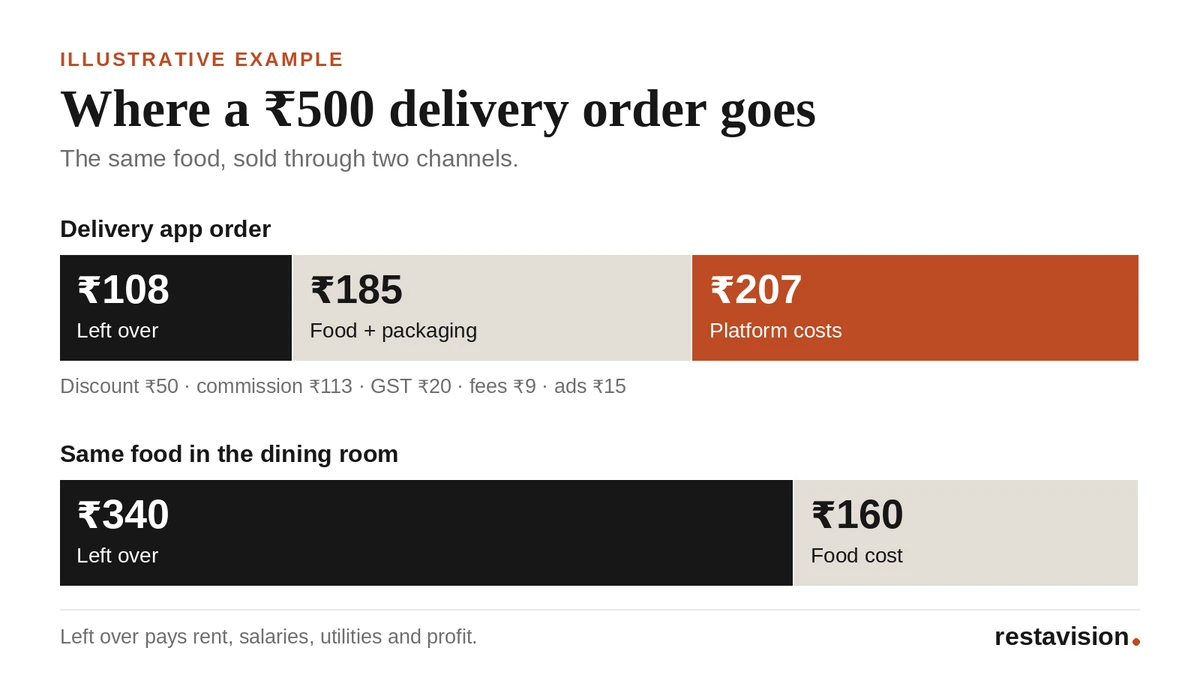
Start with one typical order and follow the money from the menu price to what is left after food and packaging. The example below uses round, illustrative figures. Replace them with the rates in your own agreement and statement.
| Line | Assumption | Amount |
|---|---|---|
| Menu price (food value) | Before GST collected from the guest | ₹500 |
| Restaurant-funded discount | 10% offer | −₹50 |
| Commission | 25% of the discounted value | −₹113 |
| GST on commission | 18%, a cost if you cannot claim input tax credit | −₹20 |
| Payment and other fees | About 2% | −₹9 |
| Ads and visibility | Monthly ad spend spread across orders | −₹15 |
| Payout to the restaurant | ₹293 | |
| Food cost | 32% of menu price | −₹160 |
| Packaging | Containers, bag, seal, cutlery | −₹25 |
| Left to cover rent, salaries and profit | ₹108 |
In this example, the restaurant keeps about ₹108, or 22% of the menu price, to pay for rent, salaries, utilities and profit. The same food served in the dining room would leave ₹340 after food cost. Delivery can still be worth doing, because it uses spare kitchen capacity and reaches guests who would not visit. But it should be priced and managed with these numbers in view.
Read the settlement statement line by line
Most leakage hides in the weekly payout statement. Download it for every outlet and every platform, and check it against your agreement and your POS data. Look for:
- Commission: is the rate the one you signed, and is it applied to the right base (food value, not GST or packaging, unless your agreement says so)?
- Discounts: which offers ran, who funded them, and did you approve each one, including any renewal or extension?
- Ads and visibility: spend by campaign, and the orders each campaign actually produced.
- Fees: payment collection, long-distance, cancellation, membership-programme and other charges, with the basis for each.
- Deductions: refunds and penalties after complaints, with the order IDs they relate to.
- GST and TDS: tax on platform fees, and tax deducted at source that your accountant should reconcile.
Raise disputes quickly, in writing, with order IDs, kitchen tickets and dispatch photos as evidence. A monthly summary of disputed amounts, raised and recovered, shows whether the effort is paying off.
Decide which discounts are actually worth running
A discount is worth running only if it brings enough extra orders to make up for the margin it gives away. Use the example above: at full price, the order leaves ₹108. With a 20% restaurant-funded discount, the same order leaves about ₹74, even after the commission falls a little on the lower value. To earn the same total, you would need roughly 46% more orders.
| Question | Why it matters |
|---|---|
| Who funds the discount? | A platform-funded offer and a restaurant-funded offer look the same to the guest but very different on your statement. |
| How many extra orders do we need? | Calculate the break-even uplift before the campaign, not after. |
| Is it capped and time-bound? | A maximum discount per order and a clear end date limit the downside. |
| Which items does it apply to? | Offers on high-contribution items or combos protect margin better than a flat percentage on the whole menu. |
| Will it renew automatically? | Approve each renewal separately and record the approval. |
After each campaign, compare orders, average order value, new versus repeat guests and contribution with the weeks before it. Keep the campaigns that pay for themselves and stop the rest.
Cut the leakage from cancellations and complaints
Refunds, remakes and penalties are a direct loss, and poor ratings also push the outlet down the app. Most of them come from a few repeat causes: missing items, wrong orders, spills, late dispatch and food that arrives cold.
- Set realistic preparation times, especially at peak hours, so orders are not marked late.
- Use an order-check step before sealing: items, add-ons, cutlery and dips against the ticket.
- Seal every bag and take a dated photo of the packed order at handover. It helps settle disputes.
- Track complaint reasons weekly and fix the top two causes first.
- Switch the outlet or specific items off when the kitchen cannot keep up, rather than accepting orders it will deliver late.
Build channels you control
Aggregators are good at bringing new guests. Repeat guests can increasingly be served through channels with lower costs and more control. Each has its own cost and effort.
| Channel | Strength | Watch out for |
|---|---|---|
| Large delivery apps | Reach, discovery and a ready delivery fleet. | Commission, discounts, ads and limited access to guest data. |
| ONDC-based apps | Lower costs on many buyer apps and wider distribution. | Smaller order volumes and costs that vary by app and city. |
| Flat-fee and zero-commission apps | A fixed fee per order instead of a percentage. | Available only in some cities; check fees, delivery and support terms. |
| Direct ordering (website, WhatsApp, phone) | Lowest cost per order and your own guest relationship. | You need delivery partners, a simple ordering flow and your own marketing. |
| Takeaway and pickup | No delivery cost and fresher food. | Works best for guests who live or work nearby. |
A practical approach is to use the large apps to be discovered and to give repeat guests a reason to order directly next time, for example with a card in the bag or a direct-order offer that costs less than the platform commission.
Run a monthly delivery profitability review
- Collect: download settlement statements for every platform and outlet.
- Reconcile: match orders and payouts with your POS and bank receipts.
- Calculate: work out net payout and delivery contribution per order, by platform.
- Review campaigns: keep only the discounts and ads that paid for themselves.
- Fix leakage: list refunds, penalties and cancellations by reason and act on the top causes.
- Adjust the menu: reprice, rework, bundle or remove delivery items that do not earn their place.
- Dispute: raise any deduction that does not match your agreement, with evidence.
The goal is not to chase the lowest commission in the market. It is to know what every delivery order earns and to make each month more controlled than the last.
See where a busy restaurant’s money usually leaks, with a quick check for each.
Ready to make delivery more profitable?
Share your format, city and current delivery challenge with Restavision.
Book a free call