
Ask a café owner what a cappuccino costs to make and the answer is usually a guess. Ask what a croissant really costs once unsold ones go in the bin, and most don’t know. That is where café profit leaks: not in one big mistake, but in a menu priced on instinct. Menu costing fixes this. Work out what every cup and plate costs to make, set a target for each category, and price so each item earns what it should. Here is how, with worked examples you can copy.
The short version
- Cost every item from its recipe, using the prices on your latest invoices.
- Add packaging and a wastage allowance. In a café these are not small.
- Compare cost with selling price (before tax) to get the cost %.
- Check it against a target for that category, and fix the outliers first.
- Re-cost whenever milk, coffee or butter prices change.
Worked example: what a cappuccino really costs
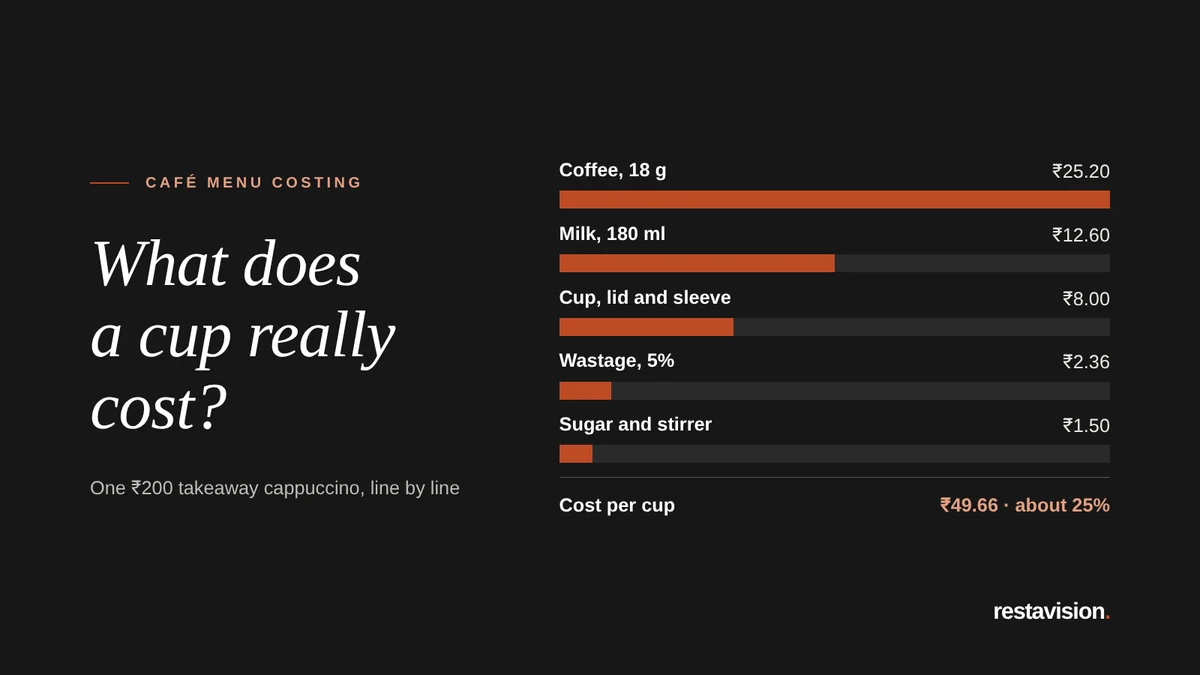
Here is the cost of one 240 ml takeaway cappuccino. The rates are examples; use the prices from your own invoices.
| Item | Quantity and rate | Cost |
|---|---|---|
| Coffee | 18 g double shot at ₹1,400 a kg | ₹25.20 |
| Milk | 180 ml (including steaming loss) at ₹70 a litre | ₹12.60 |
| Sugar and stirrer | 1 sachet and 1 stirrer | ₹1.50 |
| Cup, lid and sleeve | Takeaway | ₹8.00 |
| Wastage allowance | 5% for grinder setting, remakes and spilled milk | ₹2.36 |
| Cost per cup | ₹49.66 |
Sell it at ₹200 (before tax) and the cost is about 25%. Serve the same drink in a ceramic cup and the cost drops to ₹41.27, or about 21%, because there is no cup, lid or sleeve.
Two things owners often miss. First, milk usually costs less than coffee per cup, but it is the line that rises most often. Second, the takeaway cup can add 3–4 points of cost, so price takeaway and dine-in with that in mind.
Bakery: unsold stock is the real cost
A croissant baked in-house looks cheap to make:
| Item | Quantity and rate | Cost |
|---|---|---|
| Flour | 40 g at ₹45 a kg | ₹1.80 |
| Butter | 25 g at ₹560 a kg | ₹14.00 |
| Sugar, yeast, milk, salt, egg wash | ₹3.00 | |
| Ingredient cost | ₹18.80 | |
| Real cost if 1 in 5 is thrown away | ₹18.80 ÷ 0.8 | ₹23.50 |
At ₹140, the ingredient cost is about 13%. But if one in five is thrown away at closing, the real cost per croissant sold is ₹23.50, or about 17%. Buy the same croissant from a supplier at ₹60 and the cost is already about 43%. If one in five goes in the bin, it rises to about 54%.
The lesson: in bakery, the recipe matters less than how much you bake. Track what is left at closing every day, and bake to what sells, not to a full display.
Food: portion control is the cost
| Item | Quantity and rate | Cost |
|---|---|---|
| Bread | 2 slices | ₹6.00 |
| Paneer | 60 g at ₹400 a kg | ₹24.00 |
| Butter | 10 g | ₹5.60 |
| Cheese | 1 slice | ₹10.00 |
| Vegetables | Onion, capsicum, tomato | ₹6.00 |
| Chutney and mayonnaise | ₹5.00 | |
| Side | Chips or salad | ₹8.00 |
| Wastage allowance | 5% | ₹3.23 |
| Cost per plate | ₹67.83 |
At ₹240, that is about 28%, inside the target. Add 20 g more paneer than the recipe says and the cost rises by ₹8 a plate. Over a month of sandwiches, that is real money. Weigh the portions, photograph the plated item, and put both on the recipe card.
Target cost % by category
Use these as starting targets, then set your own once you have three months of real numbers.
| Category | Target cost % | Note |
|---|---|---|
| Hot espresso drinks | 18–25% | Usually the most profitable part of the menu. |
| Cold coffees and shakes | 22–30% | Ice cream, syrups and bigger cups push the cost up. |
| Tea and brewed drinks | 12–20% | Low cost, but often low price too. |
| Bakery made in-house | 15–25% | Only if you count unsold stock. |
| Bakery bought in | 35–45% | Little room for wastage. |
| Food: sandwiches, bowls, breakfast | 28–35% | Portion control matters most here. |
| Whole café, blended | 25–32% | Depends on how much of your sales is coffee. |
If an item is well above its target, you have three choices: change the recipe or portion, change the price, or take it off the menu. For the bigger picture, see how to calculate and control food cost.
Price ladders and add-ons
Sizes and add-ons are the cheapest profit on a café menu, because most of the cost is already in the base drink.
- Sizes. A 360 ml large cappuccino with the same double shot costs about ₹8.70 more to make than the regular. Price it ₹40 higher and the large earns more per cup, at a slightly lower cost %.
- Extra shot. 9 g of coffee costs about ₹12.60. At ₹40, it runs at about 32%.
- Plant milk. At about ₹250 a litre, 180 ml of oat milk costs about ₹45, roughly ₹32 more than dairy. Charge at least ₹60–70 extra, or every oat-milk drink earns less than the dairy one.
- Syrups and toppings. Cost per pump is small. Price them as an add-on, not free.
Combos: only if they add something
A cappuccino (₹200) and a croissant (₹140) bought separately come to ₹340. As a combo at ₹299:
- Cost of the two items: about ₹65, so about 22% of the combo price.
- Gross profit on the combo: about ₹234.
- Gross profit if the guest had bought the coffee only: about ₹159.
So a combo that turns a coffee-only guest into a coffee-and-croissant guest adds about ₹75. A combo that only discounts what the guest was going to buy anyway loses about ₹41. Build combos around items guests don’t usually add on their own, such as a bake with the morning coffee, or a drink with a lunch sandwich.
Common questions
What food cost % should a café aim for?
Across the whole menu, about 25–32% of sales before tax is a common starting target. Coffee-heavy cafés sit lower; food-heavy cafés sit higher.
Do I include packaging in the cost?
Yes, for every takeaway and delivery item. Cups, lids, sleeves, bags and boxes are part of what that item costs.
Do I include labour and electricity?
Not in food cost. Labour, power and rent are separate lines in your monthly profit and loss. Food cost is ingredients, packaging and wastage.
How often should I re-cost the menu?
Whenever a main ingredient changes price, and at least every three months. Milk, coffee and butter prices change several times a year.
Can someone do this for me?
Yes. Our menu engineering and food costing service covers recipe cards, costing and pricing for every item. Café consulting starts from ₹50,000, depending on the scope of work.
Not sure what your menu earns?
Send us your menu and a recent month of sales, and we’ll tell you where we’d start.
Book a free call