
Not every restaurant needs a consultant. Some owners hire one too early and pay for advice they cannot yet use; others wait until a costly mistake has already been made in the lease, the kitchen or the menu. This guide gives you an honest way to decide: what a consultant actually does, when outside help usually pays for itself, when it probably does not, and a quick self-check you can answer in five minutes.
What a restaurant consultant actually does
A good restaurant consultant brings three things you cannot easily build alone: systems that have already been tested in other kitchens, an outside view of problems that are hard to see from the inside, and speed, because the common mistakes have been seen before.
What a consultant does not do is run your restaurant. The owner, chef and managers still make it work every day. The consultant's job is to set up the menu, systems, controls and training so the team can run it well, and to leave you less dependent on outside help over time, not more.
When hiring a consultant usually pays off
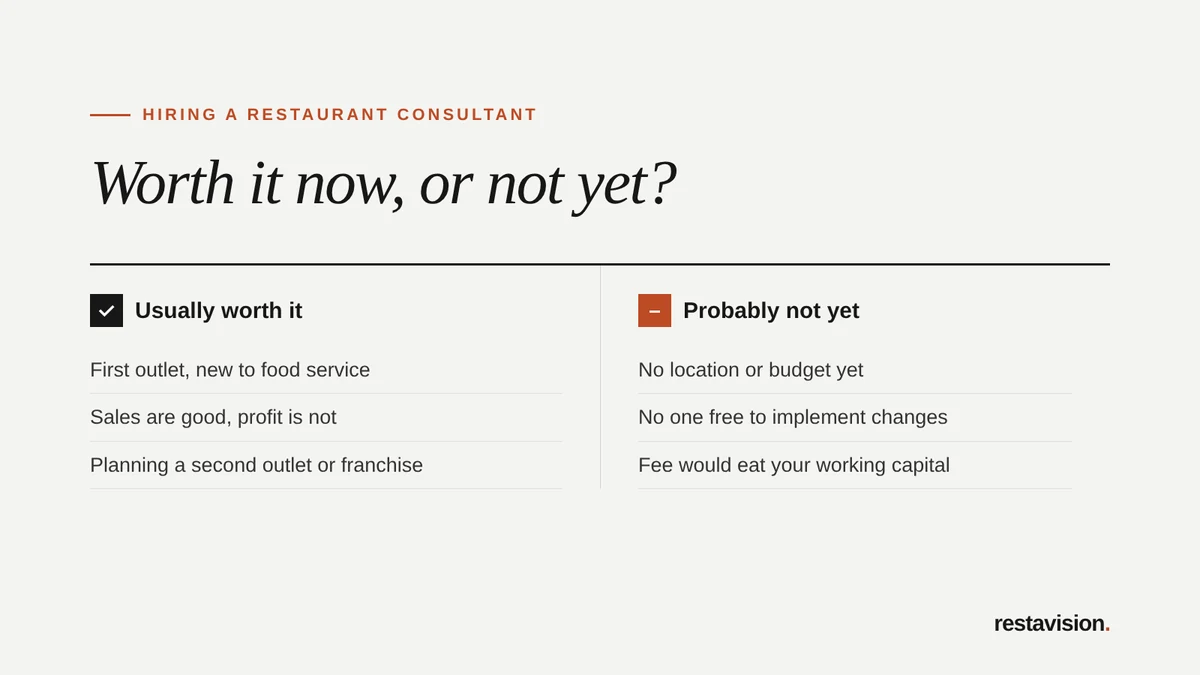
- You are opening your first outlet without food-service experience. Kitchen layout, equipment, licences, hiring and pricing all have to be right before day one, and mistakes here are expensive to undo. See the opening mistakes behind many struggling outlets.
- A large fit-out is about to be committed. Advice on kitchen flow and equipment before construction costs far less than rebuilding after it.
- Sales are good but profit is not. High food cost, wastage, portion drift or delivery commissions are usually fixable with costing and controls.
- Quality changes from shift to shift. Without SOPs and training, the outlet depends on a few people, and every staff change shows up on the plate and in reviews.
- Hygiene or audit problems keep returning. Repeated issues usually mean the system is missing, not just the effort.
- Ratings are slipping. Falling Google or Zomato ratings are often an operational problem that shows up online.
- You are planning a second outlet or a franchise. What works because the owner is present has to be written down before it can be repeated.
When you probably don't need one yet
Being honest about this saves you money and makes any later engagement more useful.
- The idea has no location or budget yet. Do your homework first: visit similar outlets, set a rough budget and shortlist areas. A consultant is more useful once there are real decisions to make.
- You need one specialist, not a consultant. If the only gap is accounts, interiors or legal paperwork, hire that specialist directly.
- Nobody has time to implement. If no one in your team can own the changes, the recommendations will stay on paper. Fix that first.
- The budget would eat your working capital. Running out of cash in the first months is a bigger risk than opening without advice. Start with free guides or one small, focused piece of work.
A five-minute self-check
Answer yes or no to each question.
- Is this your first restaurant, or a new format you have not run before?
- Are you about to sign a lease or commit to a fit-out?
- Is your food cost above your target, or do you not know it accurately?
- Does the food or service change noticeably when key people are away?
- Have hygiene, audit or licence issues come up more than once?
- Have your online ratings fallen in the last three months?
- Are you planning a second outlet or a franchise in the next year?
Three or more "yes" answers usually mean focused outside help will pay for itself. One or two point to a single area worth fixing, often a small engagement. None? Keep going on your own, and use our guides as a reference.
How to get the most from a consultant
- Agree one clear goal before the work starts, such as a food cost target, an opening date or an audit score.
- Give access to real numbers: sales, purchases, recipes and staff schedules.
- Name an owner in your team who will carry each change forward.
- Start focused, then expand once you have seen results.
- Plan the handover so your team can run the systems without the consultant.
Ready to compare consultants? Use How to Choose a Restaurant Consultant: the questions to ask in the first meeting and the red flags to walk away from.
What it costs
At Restavision, consulting starts from ₹50,000 and can go up to ₹10 lakh, depending on the scope of work. A single focused job sits at the lower end; a full new-outlet launch or franchise setup sits at the higher end, usually on a retainer for ongoing handholding. See How Much Does Restaurant Consulting Cost? for what each level includes.
Talk it through first
Share your format, stage and what is holding the business back. A short call is often enough to tell whether you need outside help.
Book a free call