
The right restaurant consultant is not the one with the biggest list of brands. It is the one who will put the exact work, the price and the person doing it in writing before you pay. Most owners hire a consultant once or twice in their life, so they judge on a good first meeting and a confident pitch. That is how money gets spent on reports nobody uses, or on a launch where the consultant disappears after opening day. This guide gives you a short way to check any consultant.
In short
| Stage | What to do |
|---|---|
| Before you look | Write down the one problem you are paying to fix, and your budget band. |
| First meeting | Ask who does the work, what you will receive, and how success is measured. |
| Red flags | Guaranteed results, no written scope, pushed vendors, no past clients you can call. |
| The proposal | Named deliverables, timeline, payments in stages, and what is not included. |
| Checking past work | Speak to two past clients and, if you can, visit an outlet they worked on. |
| Fees | Consulting starts from ₹50,000 and can go up to ₹10 lakh, depending on the scope of work. |
Know what you need before you start looking
A consultant can only be judged against a clear job. If you cannot say what you are paying for, every pitch will sound right. Before you speak to anyone, write down three things.
- The problem in one sentence. For example: “Food cost is too high and I don’t know where it leaks”, or “I want to open my second outlet and need systems the team can follow without me.”
- What “fixed” looks like. A costed menu, a set of SOPs your staff actually use, a passed food safety audit, an outlet open on a date.
- The type of job. One focused job (menu costing, an SOP set, a food safety audit), fixing several areas of an outlet that is already running, or a full new-outlet launch or franchise setup over several months.
If you are not sure you need outside help at all, read Do You Need a Restaurant Consultant? first. Sometimes the honest answer is no.
9 questions to ask in the first meeting
A good consultant will be glad you asked these. Vague answers tell you more than the pitch did.
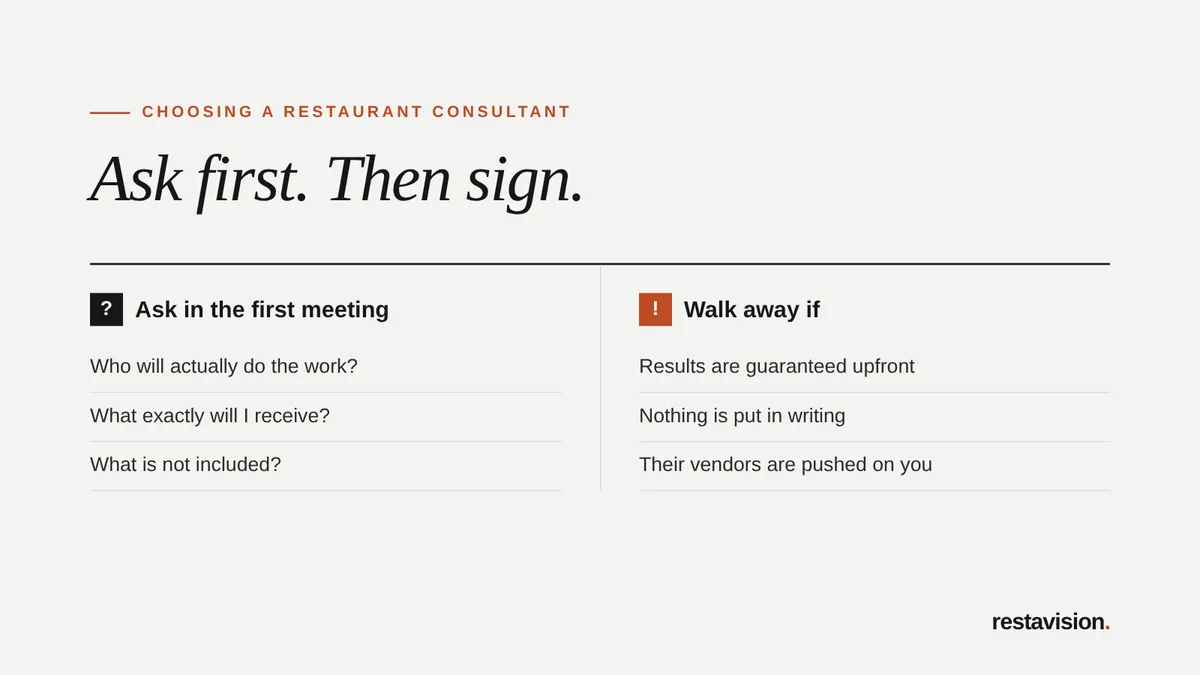
- Who will actually do the work, and how often will they be at my outlet? Good answer: A named person, and a clear number of visits or days.
- What exactly will I receive at the end? Good answer: A list of documents, sheets, trainings and checks, with formats.
- What is not included? Good answer: They name it without being pushed, such as interiors, licence fees or hiring.
- How will we know it worked? Good answer: One or two measures agreed now, such as food cost %, audit score or opening date.
- How do you charge, and when do I pay? Good answer: A written quote, with payment in stages tied to deliverables.
- Do you earn anything from vendors you recommend? Good answer: A straight yes or no. If yes, they tell you how much.
- Have you worked with my format before? Good answer: Specific examples for your café, QSR, cloud kitchen or bar, and honesty if it is new to them.
- Can I speak to two past clients? Good answer: Names and numbers, shared with the client’s permission.
- What happens when you leave? Good answer: A handover: your team is trained and the files are yours.
In our experience, owners ask about the consultant but rarely about their own business. Is my current team capable of handling the change? Do I need to upgrade my technology or software? Will I need to hire more staff? Ask these before you sign. The answers decide the real cost of the change, not just the consultant’s fee.
8 red flags to walk away from
One red flag is a reason to ask harder questions. Two or more is a reason to keep looking.
- Guaranteed results. Promised footfall, profit or a rating before they have seen your numbers. Nobody can promise sales; a consultant who does is selling the feeling, not the work.
- No written scope. “We’ll take care of everything.” If it isn’t written, you can’t hold them to it, and every extra becomes a new bill.
- Vendors pushed on you. They insist on their own suppliers, contractors or software. Your kitchen gets chosen for their margin, not your menu.
- Copy-paste work. SOPs or menus that still carry another brand’s name, or were written for a format that isn’t yours. Templates are a starting point; you are paying for them to be made yours.
- Everything paid upfront. The full fee before any work, with no stages. You lose your only leverage if the work slips.
- No one you can call. They can’t or won’t connect you with a single past client. Logos on a website are easy; a client willing to talk is not.
- The seller isn’t the doer. A senior person pitches, and a junior you never met does the work. Ask to meet the person who will be at your outlet.
- Shortcuts on reviews or compliance. Offers to buy reviews or “manage” an inspection. It puts your licence and your name at risk, and platforms remove fake reviews.
We know of a project where the consultant shared the wrong civil and interior quotation, then changed the entire plan midway. The owner ended up paying 20% more than planned. A written scope, and a quote you can hold them to, is what stops this.
Our own policy: Restavision never takes commission from any vendor, and owners are always free to bring their own vendors.
What a good proposal includes
A proposal is where a good first meeting either turns into something you can hold them to, or doesn’t. Before you sign, check it has all of these:
- The problem, written in your words, so you know they understood it.
- Every deliverable named, with its format: costing sheet, SOP manual, audit report, training sessions.
- The person or people doing the work.
- A timeline with dates or weeks for each stage.
- Payment in stages, each tied to a deliverable.
- What is not included.
- How success will be measured.
- What you own at the end: files, recipes, SOPs.
What it costs
Consulting starts from ₹50,000 and can go up to ₹10 lakh, depending on the scope of work.
| Type of job | Typical range |
|---|---|
| One focused job (menu costing, an SOP set, a food safety audit) | ₹50,000 – ₹1.5 lakh |
| Fixing several areas of a running outlet | ₹1.5 lakh – ₹4 lakh |
| Full new-outlet launch or franchise setup, usually on retainer | ₹4 lakh – ₹10 lakh |
Bigger, longer projects work best on a retainer, so you get ongoing handholding rather than a one-time report. Either way, you should get a written scope and quote before any work starts. A very low quote is not always a saving: ask what has been left out of it. For the full breakdown, see How Much Does Restaurant Consulting Cost?
How to check a consultant’s past work
Ten minutes on the phone with a past client tells you more than any website. When you call, ask:
- What did they deliver, and was it what was promised?
- Did the same person who pitched actually do the work?
- Is your team still using what they built, six months on?
- Did the cost stay close to the quote?
- Would you hire them again for the next outlet?
If you can, visit an outlet they worked on and eat there as a normal guest. Systems that work show up on a busy evening, not in a slide deck. Many of the mistakes behind struggling new outlets are visible from a guest’s table.
Why “best consultant” lists won’t decide this for you
Search for the best or top restaurant consultants and you will find ranked lists. Many are written by the firms on them, or by sites paid to include them. Even an honest list can’t tell you whether a consultant fits your format, your budget and your problem.
Use lists to make a shortlist if you like. Then let the questions, the red flags and the proposal checklist above make the decision.
Common questions
How many consultants should I speak to before choosing?
Two or three is usually enough. Give each the same one-sentence problem so you can compare their answers and proposals side by side.
Should I choose the consultant with the most famous clients?
Not on that alone. Ask who from that team will work on your outlet, and speak to a client whose size and format are close to yours.
Is it a bad sign if a consultant won’t guarantee results?
No, it is usually a good one. A consultant can commit to deliverables, timelines and agreed measures. Promising sales or profit before seeing your numbers is a red flag.
Can I hire a consultant for just one part of the job?
Yes. Many owners start with one focused job, such as menu costing or a food safety audit, and decide on more after seeing the work.
What should I have ready before the first meeting?
Your one-sentence problem, rough monthly sales and costs if you are already open, your menu, and your budget band.
Talk it through before you hire anyone
Book a free call and we’ll tell you honestly whether you need a consultant, and what the job should include.
Book a free call