
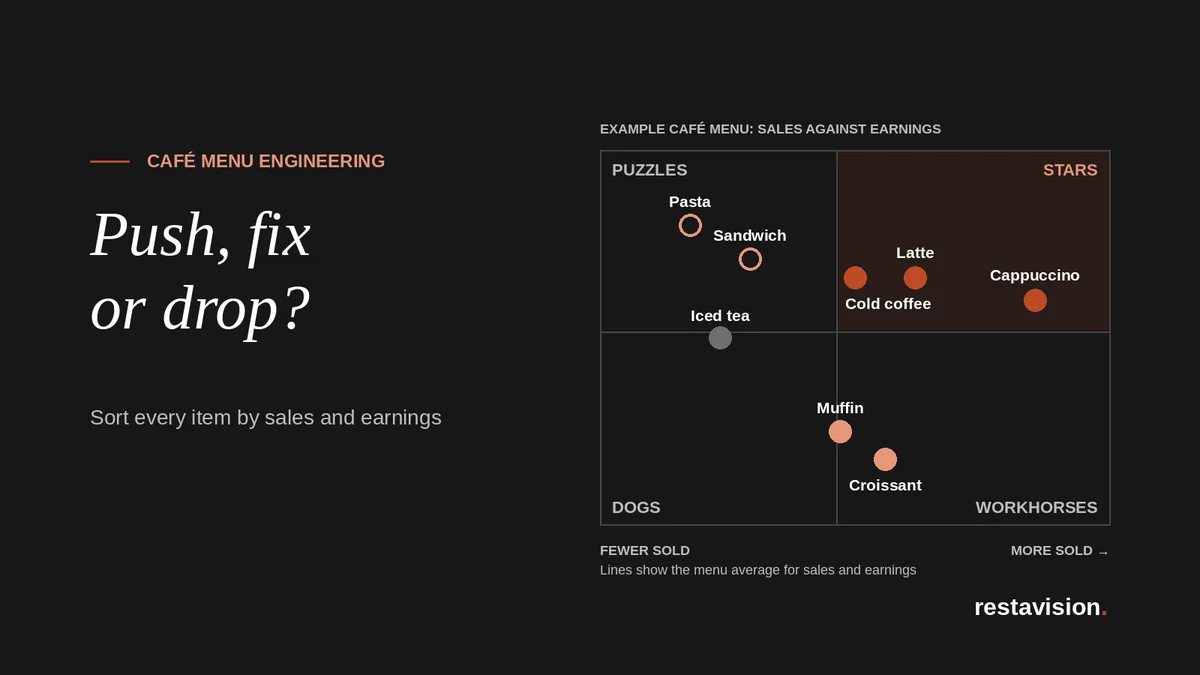
Most café menus grow by accident. An item is added because a customer asked, a supplier offered a deal or the owner liked the idea, and few items ever leave. Menu engineering is a simple way to decide, with your own numbers, which items to push, which to fix and which to drop. This guide shows the method on an example café menu.
The short answer
Sort every item by two numbers: how many you sell, and how many rupees each one earns. Stars sell well and earn well, so protect them. Workhorses sell well but earn less, so fix the margin. Puzzles earn well but sell less, so sell them harder. Dogs do neither, so drop them. Repeat the sort every month.
Get the two numbers for every item
- Items sold a month: from the sales report by item in your billing system.
- Rupees earned per item: the selling price before tax, minus the real cost of making it. Real cost includes ingredients, packaging and a wastage allowance. Our café menu costing guide shows how to work it out.
Then find two averages for the whole menu: the average number of items sold per menu item, and the average rupees earned per item sold. Every item is compared against those two averages.
A worked example
This is an example menu with example rates, not a real café. Across the eight items, the café sells 5,100 items a month, so the average menu item sells about 638. Dividing total earnings by items sold gives an average of about ₹133 earned per item.
| Item | Price | Real cost | Earns per item | Sold a month | Group |
|---|---|---|---|---|---|
| Cappuccino | ₹200 | ₹50 | ₹150 | 1,300 | Star |
| Latte | ₹220 | ₹58 | ₹162 | 900 | Star |
| Cold coffee | ₹240 | ₹78 | ₹162 | 700 | Star |
| Iced tea | ₹180 | ₹50 | ₹130 | 250 | Dog |
| Croissant (bought in) | ₹140 | ₹75 | ₹65 | 800 | Workhorse |
| Chocolate muffin | ₹150 | ₹70 | ₹80 | 650 | Workhorse |
| Paneer sandwich | ₹240 | ₹68 | ₹172 | 350 | Puzzle |
| Pasta bowl | ₹320 | ₹130 | ₹190 | 150 | Puzzle |
The bought-in croissant counts a real cost of ₹75 because one in five goes unsold, as in our costing guide. Notice that the pasta bowl has a higher cost percentage than the iced tea (about 41% against 28%) and still earns ₹190 a plate against ₹130. That is why the sort uses rupees, not percentages.
What to do with each group
- Stars (cappuccino, latte, cold coffee): these carry the café. Keep the recipe and portion exactly the same every time, put them first on the menu board, and avoid discounting them.
- Workhorses (croissant, muffin): customers already want them, so the work is on the margin. Check the recipe and the portion, look for a cheaper way to buy the same quality, or raise the price a little. A ₹10 rise on a croissant selling 800 a month is worth ₹8,000 a month if sales hold, so watch the units for two weeks after the change.
- Puzzles (paneer sandwich, pasta bowl): these earn well but few people order them. Move them somewhere more visible, describe them better, and train the counter team to suggest them. Each extra sandwich earns ₹172, so 100 more a month is about ₹17,200.
- Dogs (iced tea): few people order it and it earns less than average. Drop it, or replace it with something that earns more. If you keep it for a reason, such as customers who do not drink coffee, make sure it is not tying up stock.
Look at dine-in and delivery separately
A café that also sells through delivery apps should sort each channel on its own, because commission changes what an item really earns. Our menu engineering guide covers that, and what aggregator commission does to your margins shows the effect.
A monthly review routine
- Export the sales report by item for the month.
- Update real costs for any ingredient whose price has changed.
- Recalculate the two averages and sort the items.
- Choose one change per group: a price test, a repositioned item, a dropped item.
- Check the units again next month before making another change.
Common questions
What is menu engineering for a café?
Menu engineering sorts every menu item by how many you sell and how many rupees each one earns, so you know which items to push, fix or drop. Stars sell well and earn well, Workhorses sell well but earn less, Puzzles earn well but sell less, and Dogs do neither.
Why use rupees earned instead of cost percentage?
Because you pay your bills in rupees, not percentages. In the example, the pasta bowl has a higher cost percentage than the iced tea (about 41% against 28%), yet it earns ₹190 a plate against ₹130.
What counts as selling well?
Selling more than the average item on your menu. Add up all items sold and divide by the number of items. The same goes for earnings: compare each item with the average rupees earned per item sold.
How often should I redo the sort?
Once a month, using the sales report from your billing system. Redo it sooner after a price change, a new item or a big change in ingredient costs.
Should I always remove Dogs?
Usually, because every slow item is stock that can expire. Keep one only if it brings in customers who would not otherwise come, such as a non-coffee drink for a group, and check that it is not costing you more than it earns.
Do I need special software?
No. A sales report by item from your billing system and a simple spreadsheet are enough to do the sort.
See how to reduce food cost in a café without hurting quality.
Get your menu working harder
Share your menu and sales, and we’ll show you which items to push, fix or drop.
