
Café owners often try to cut food cost by cutting the ingredient customers can taste, and then wonder why sales fall. The money is usually elsewhere: in portions that drift, bakery that goes in the bin, buying without a specification, and a menu that sells the wrong things. This guide shows where café food cost leaks and how to close each leak without touching quality.
The short answer
Cut waste, not ingredients. Start by costing every recipe and weighing every portion. Then bake to what sells, buy by specification, log your wastage, and sell more of the items that earn more. Change one thing at a time, and watch sales and complaints after each change.
Know your number first
You cannot cut what you have not measured. Work out your actual food cost: opening stock plus purchases minus closing stock, divided by sales. Compare it with what your recipes say it should be. The gap is your waste, over-portioning and anything else unaccounted for. Our food cost control guide shows the method, and the café menu costing guide gives starting targets by category.
What one point is worth
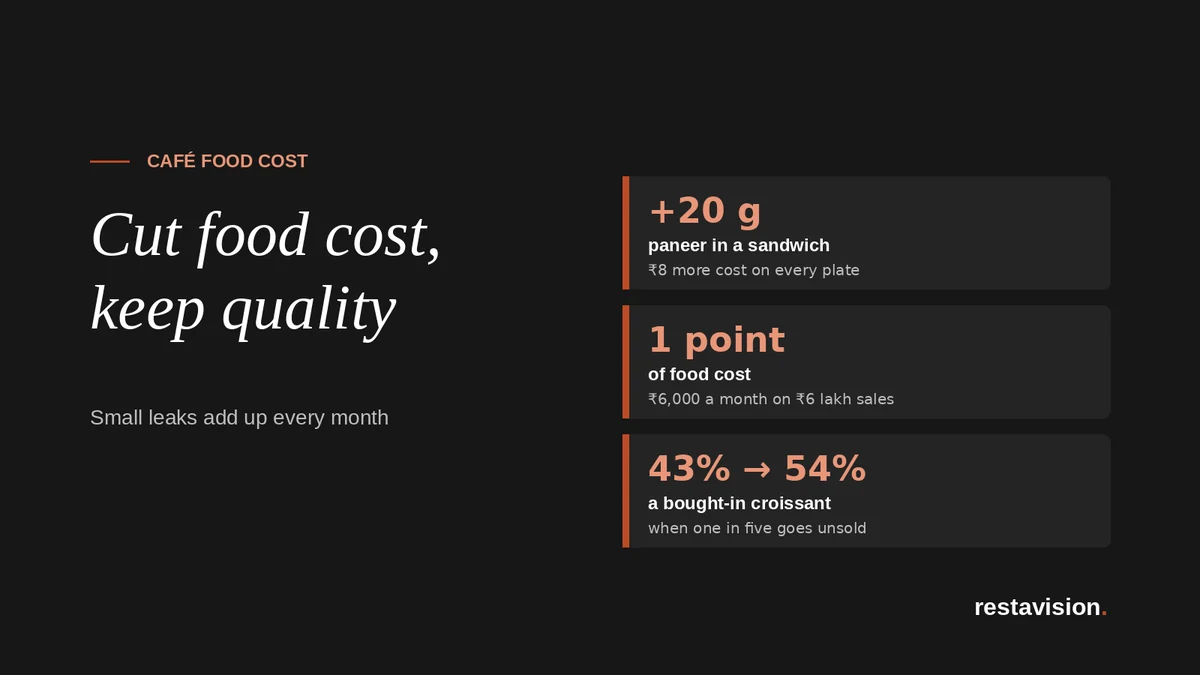
One percentage point of food cost is one percent of your sales. At ₹6 lakh a month in sales, one point is ₹6,000 a month. A café selling 100 cups a day at ₹200 turns over ₹20,000 a day, so one point is ₹200 a day. Small points add up, which is why portions and wastage matter more than a dramatic menu change.
Eight places to look
- Recipes and portions: weigh every portion and put it on a recipe card. In our costing guide, 20 g more paneer than the recipe says adds ₹8 to every sandwich.
- Bakery and unsold stock: track what is left at closing and bake to what sells. In the same guide, a bought-in croissant costing 43% rises to about 54% if one in five goes in the bin.
- Buying: get quotes from at least three vendors for exactly the same specification, and check the price again after the first order. Restavision takes no vendor commission, and you are free to use your own vendors.
- Wastage: log everything thrown away for two weeks, with the reason, and start with the biggest category.
- Storage: label and date everything, use the oldest first, and check fridge temperatures so food does not spoil early.
- Menu mix: promote the items that earn the most rupees and rethink the ones that earn the least. See café menu engineering.
- Pricing: when an ingredient’s cost rises, adjust the price a little rather than quietly shrinking the portion.
- Training: a team that follows the same recipe and portion every time keeps cost steady without any extra rule.
How to cut cost without hurting quality
- Protect what customers taste: coffee beans, milk and the main ingredient in each dish are not where to save.
- Change one thing at a time: if you change three things and sales drop, you will not know which one did it.
- Taste before you switch: blind-taste any substitute with your team before it reaches a customer.
- Watch for two weeks: track sales of the item, repeat orders and complaints after every change.
- Buy by specification, not by price: the same item at a better price is a saving, and a cheaper different item is a recipe change.
A monthly routine
- Calculate actual food cost for the month.
- Compare it with what your recipes say it should be.
- Look at the wastage log and pick the biggest cause.
- Re-cost any item whose ingredient prices have moved.
- Make one change, and check its effect next month.
Common questions
How can a café reduce food cost without lowering quality?
Cut waste, not ingredients. Cost every recipe, weigh portions, bake to what sells, buy the same specification from the best-priced vendor, log wastage, and sell more of the items that earn more. Quality drops when you cut what customers taste, not when you cut what is thrown away.
What is a good food cost for a café?
It depends on the mix of drinks, bakery and food. Our café menu costing guide gives starting targets by category, from about 18–25% for hot espresso drinks to 28–35% for food. Set your own targets once you have three months of real numbers.
How much is one percentage point of food cost worth?
It is one percent of your sales. At ₹6 lakh a month, one point is ₹6,000 a month. A café selling 100 cups a day at ₹200 turns over ₹20,000 a day, so one point is ₹200 a day.
Should I switch to a cheaper supplier?
Only for the same specification, and only after a trial. Compare quotes for exactly the same item, order a small quantity first, and check quality and delivery before you move the whole order.
How do I find out where my waste is?
Log everything thrown away for two weeks, with the reason: spoilage, preparation waste, mistakes or returns. The biggest category tells you where to start.
How often should I review food cost?
Monthly, comparing what you should have spent with what you did spend, and re-costing items whenever the price of milk, coffee or butter changes.
Bring your café food cost down
Share your recipes, purchases and sales, and we’ll show you where the money is going.
