
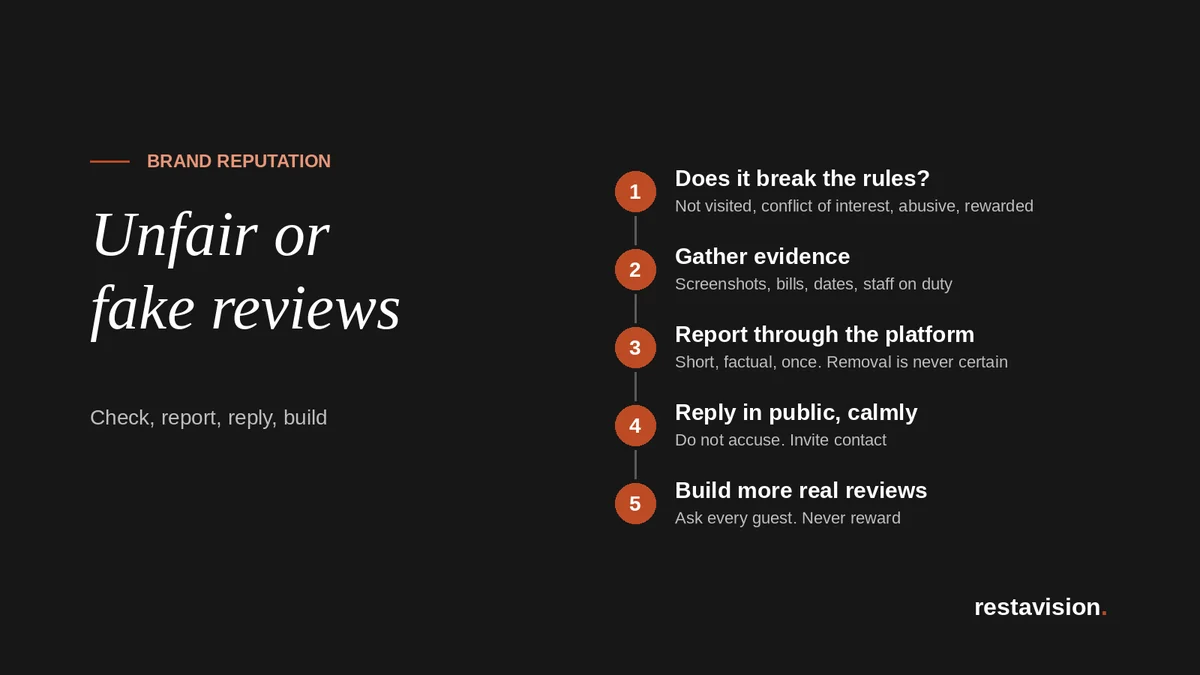
Some negative reviews are harsh but real. Others come from people who never visited, from competitors or from a grudge. The difference matters, because only some can be reported and removed. This guide covers how to tell them apart, what evidence to keep, how to report and reply, and what not to do.
The short answer
Unfair is not the same as fake. A platform removes reviews that break its content rules, not reviews you disagree with. Check the review against the rules, keep your evidence, report it through the platform, and reply politely in public. Then build a larger base of real reviews so a single bad one counts for less. No one can guarantee removal, so be wary of anyone who promises it.
Unfair, fake or just negative?
| Type | Example | Best response |
|---|---|---|
| Honest but harsh | A guest found the food cold and says so strongly | Reply calmly, fix the cause. Not reportable |
| Unfair but real | A guest is angry about a policy they were told about | Reply with facts, politely. Usually not reportable |
| Likely fake | No record of the visit, details do not match your menu or hours | Check your records, report it, reply briefly |
| Conflict of interest | A competitor, a former employee or a friend of a rival | Gather evidence and report it. Do not accuse in public |
| Abusive or off-topic | Insults, threats, or a complaint about something unrelated to your restaurant | Report it under the content rules |
| Review in exchange for a reward | Reviews posted for a discount or payment | Do not do this yourself. Report if you see it from others |
Gather evidence first
- Screenshot the review with the date, the name and the full text.
- Search your billing records for the date and time. Note whether any bill, order or booking matches.
- Ask the manager and staff on duty what they remember.
- Check your CCTV or order log if the claim is about something specific, and follow your own rules on keeping footage.
- Write down why the review looks wrong in two or three plain sentences.
Report it through the platform
Use the reporting option next to the review, choose the reason that fits and add a short, factual explanation. Platforms decide on their own rules and timelines, so removal is never certain. If your first report is turned down, look again at the rules before trying once more. Repeated identical reports rarely help.
Reply in public, calmly
Even while a report is pending, reply. Keep it short, factual and polite.
Thank you for your feedback. We have checked our records and could not find a visit that matches your description. We take every review seriously, so please contact us at [phone or email] and we will look into it.
Do not call the review fake or the guest a liar. Readers should come away thinking the restaurant is fair, whatever the truth of the review. Our guide to replying to negative reviews has more samples.
What not to do
- Post fake positive reviews yourself or through friends and staff.
- Pay a service to remove reviews or to flood your page with praise.
- Offer discounts for reviews. Platforms generally do not allow rewarded reviews, so check their current rules.
- Threaten the reviewer or contact them privately to pressure them.
- Reveal private details about the guest.
- Blame the platform in a public reply.
Make one bad review matter less
The best defence is a large number of real reviews. Ask every guest, in a natural way, and make it easy: a QR code at the table or on the bill. A restaurant with hundreds of honest reviews is less affected by one unfair one than a restaurant with a handful. Our guide on improving Google and Zomato ratings covers the habits, and the Google Business Profile guide covers keeping your listing accurate.
A note on the rules
Platforms update their review policies, and India has been developing guidelines on online reviews, so check each platform’s current rules before you act. This guide is general information, not legal advice. If a review makes a serious false claim, speak to a lawyer.
Common questions
Can I get a bad review removed?
Only if the review breaks the platform’s content rules, and the platform decides. A review that is simply negative, harsh or unfair to you usually stays.
What counts as a fake review?
Generally, a review by someone who has not visited, a review by someone with a conflict of interest such as a competitor, an owner or a friend, or a review written in exchange for payment or a reward. Check each platform’s current rules for its exact wording.
Should I reply to a review I believe is fake?
Often yes, briefly and politely, saying you cannot find a record of the visit and inviting contact. Do not accuse the reviewer of lying. Report it as well.
Can I pay someone to remove a bad review?
Do not. Paying for removal or for new positive reviews is the kind of behaviour platforms and consumer rules are aimed at, and it can damage your listing and your name.
Can I ask happy guests for reviews?
Yes, ask every guest in a natural way, for example with a QR code. Do not offer discounts or gifts in exchange for a review, and do not ask only for positive ones.
Is there a legal route?
Sometimes, for clearly false statements of fact or abuse. That is a matter for a lawyer. Start with the platform’s reporting tools and keep your evidence safe.
Protect your restaurant’s reputation
Share what you are seeing and we will tell you what can be done.
