
Most food businesses find out how ready they are for an inspection on the day the inspector arrives. A food safety audit moves that discovery earlier, to a day when finding a gap costs you a to-do list instead of a problem. This guide explains what a food safety readiness audit covers, how a visit runs, what you get at the end and how to prepare.
The short answer
Restavision’s food safety audit is a pre-inspection readiness audit. A team member visits your outlet for about 3 to 4 hours and checks storage, cooking, general hygiene, pest control, records and licences against FSSAI’s Schedule 4 hygiene requirements. You get the score and an action plan to improve it, with the score shared within 24 hours of the visit.
What it is, and what it is not
Schedule 4 of the Food Safety and Standards (Licensing and Registration of Food Businesses) Regulations, 2011 sets the hygiene requirements for licensed food businesses. Part II sets the general requirements, and Part V adds the requirements for catering and food service. A readiness audit walks your outlet against those requirements and tells you where you stand.
- It is a readiness check. It helps you find and fix gaps before anyone official arrives.
- It is not an inspection, a licence or a rating. Official inspections, licences and FSSAI’s own Hygiene Rating scheme are separate processes under FSSAI’s rules, and this audit does not replace them.
- It is not an FSSC 22000 certification. Our founder, Sandeep Goel, holds an Internal Auditor certificate for FSSC 22000 Version 6, which is a different standard from the one this audit is measured against.
What the audit covers
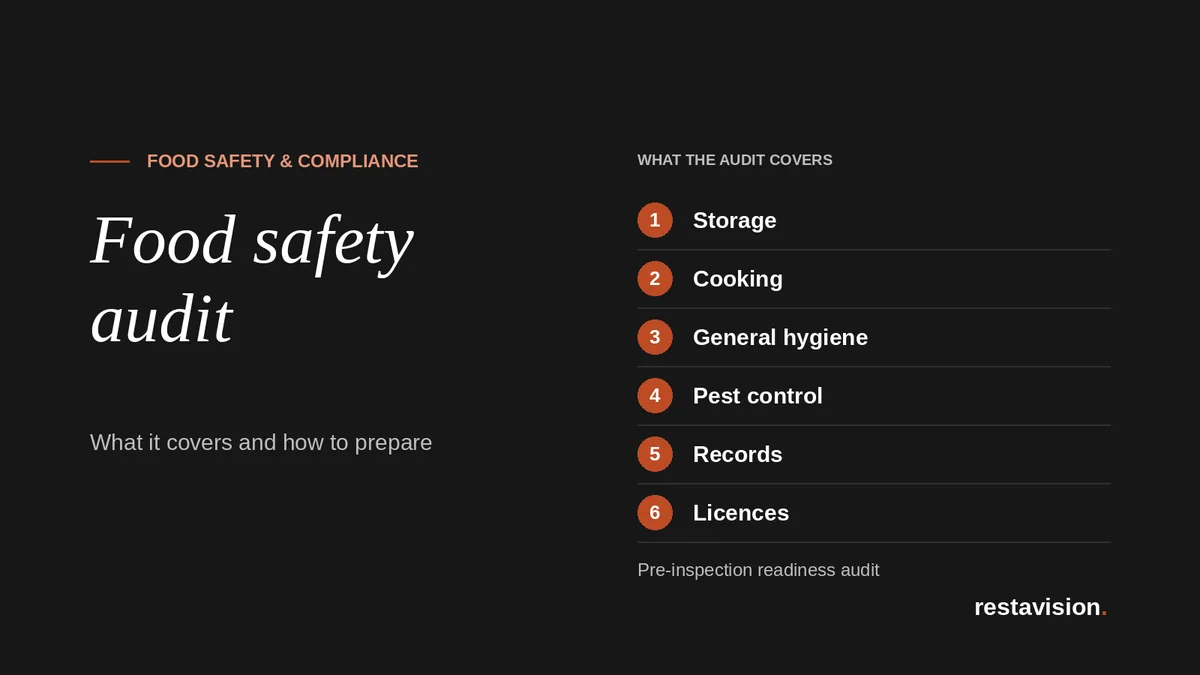
The audit covers the essential points of the FSSAI hygiene requirements in six areas. These are the kinds of checks made under each.
| Area | Typical checks |
|---|---|
| Storage | Raw and cooked food kept apart, labelling and dating, first in first out, fridge and freezer temperatures, condition of dry stores |
| Cooking | Cooking and holding temperatures, cross-contamination between raw and ready-to-eat food, cleanliness of equipment and utensils |
| General hygiene | Cleanliness of the premises, handwashing facilities, staff hygiene and clothing, water and waste handling |
| Pest control | Signs of pests, how the premises are proofed, and whether pest control is carried out and recorded |
| Records | The records the regulations expect, such as cleaning, temperature, pest control and staff training |
| Licences | FSSAI licence or registration in date and displayed, and the other documents the business must hold |
For the daily practices behind these checks, see our restaurant hygiene and FSSAI compliance guide, and for the licence itself, the restaurant licences guide.
How the audit runs
- Book a free call: tell us the type of outlet and what you want checked.
- A team member visits: about 3 to 4 hours on site.
- The walk-through: storage, cooking, general hygiene, pest control, records and licences, against the Schedule 4 hygiene requirements.
- The score: shared by the same team member within 24 hours of the visit.
- The action plan: a list of what to fix to improve the score.
What you get at the end
Two things: an audit score based on the FSSAI guidelines, and an action plan to improve that score. The score tells you where you stand, and the plan tells you what to do about it, so the audit ends with work you can start the same week.
Who it is for
The audit is for cafés, restaurants, QSRs, cloud kitchens, catering establishments, bakeries and any food production unit. If you prepare, store or serve food, the same six areas apply to you, though the checks differ by format.
How to prepare for the visit
- Have your licence or registration ready: in date and displayed where it should be.
- Gather your records: cleaning, temperature, pest control and staff training.
- Walk through storage yourself: raw and cooked food apart, everything labelled and dated, fridge and freezer temperatures noted.
- Check your pest control paperwork: the contract and the record of the last visit.
- Brief the team: tell staff what the visit is for, so it is a check and not a surprise.
- Nominate one person: someone who can walk the auditor around and answer questions.
- Do not stage a clean-up: the audit is most useful when it sees how the outlet runs on a normal day.
What to do after the audit
- Fix the highest-risk items first: anything that could make food unsafe, such as temperatures and cross-contamination, comes before paperwork.
- Give every action an owner and a date: a fix with no name next to it rarely happens.
- Turn fixes into routines: put daily checks into your SOPs so the score does not slip back.
- Re-check against the same checklist: so you can see whether the score has moved.
Our operations and SOP consulting turns audit findings into SOPs, training and checklists your team can follow every day. To check how the whole business runs, not only hygiene, see our guide to the restaurant operations audit.
Common questions
What is a food safety audit?
A food safety audit is a structured visit that checks how an outlet stores, cooks, cleans and records against a standard, and gives a score and a list of fixes. Restavision’s version is a pre-inspection readiness audit, measured against FSSAI’s Schedule 4 hygiene requirements.
Is this an official FSSAI inspection or rating?
No. It is a readiness check that helps you find and fix gaps before an official inspection. It does not replace an FSSAI inspection, a licence or any FSSAI rating.
How long does the visit take?
About 3 to 4 hours on site, carried out by a Restavision team member.
How soon do I get the score?
The team member shares the score within 24 hours of the visit.
What do I get at the end?
An audit score based on FSSAI guidelines, and an action plan to improve that score.
Which businesses is it for?
Cafés, restaurants, QSRs, cloud kitchens, catering establishments, bakeries and any food production unit.
Do I need to prepare before the visit?
A little. Have your licence or registration, and your cleaning, temperature, pest control and training records, ready to show. Do not stage a special clean-up, because the audit is most useful when it sees a normal day.
See the restaurant licences guide for what to arrange before you open.
Book a food safety audit
Tell us your outlet type and what you want checked, and we’ll take it from there.
