
Most restaurant owners know something is off before they know what. Sales look fine, but profit does not. Shifts run differently depending on who is in charge. Food cost drifts, and the same complaints come back. An operations audit looks at the whole business and tells you where control is slipping. This guide explains what Restavision’s operations audit checks, what you get at the end and when it is worth doing.
The short answer
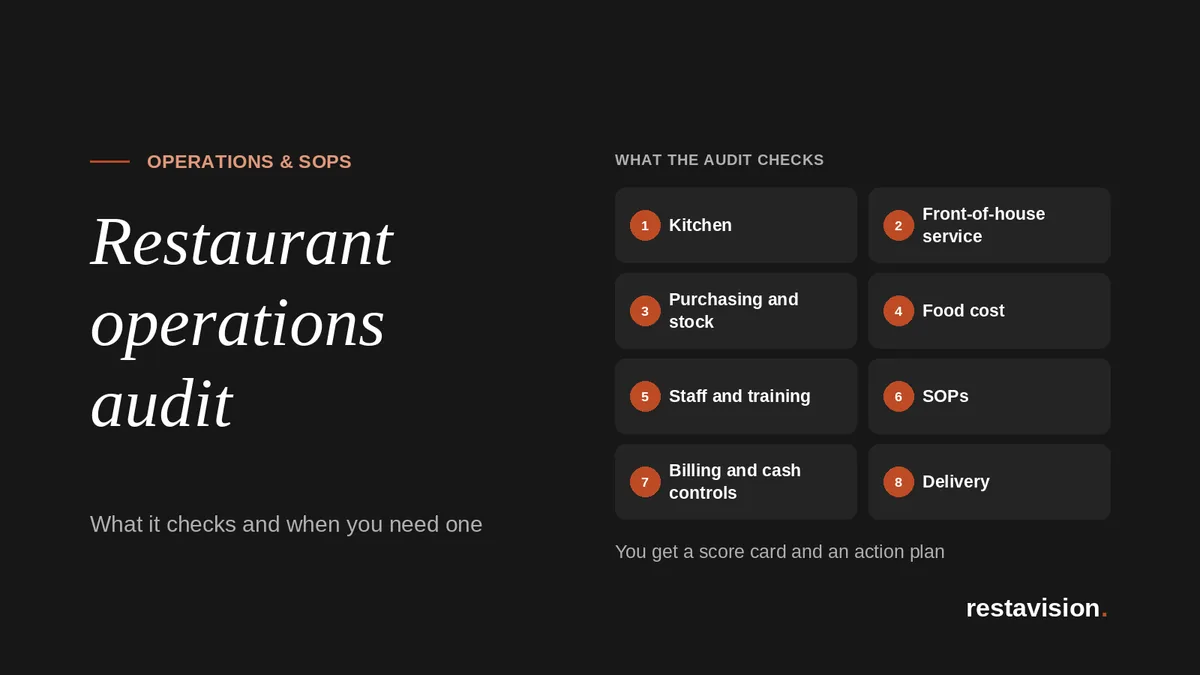
An operations audit checks how your whole business runs, not just one department. Restavision’s audit covers eight areas: kitchen, front-of-house service, purchasing and stock, food cost, staff and training, SOPs, billing and cash controls, and delivery. You get a score card and an action plan to improve the score. A larger establishment takes 2 to 3 days on site.
How it differs from a food safety audit
The two audits answer different questions, and many outlets benefit from both.
| Compared | Food safety audit | Operations audit |
|---|---|---|
| What it covers | Hygiene and FSSAI readiness | How the whole business runs |
| The question it answers | Are we ready for an inspection? | Where are we losing control, time or money? |
| What you get | An audit score and an action plan | A score card and an action plan |
| Time on site | About 3 to 4 hours | 2 to 3 days for a larger establishment |
Read our guide to the food safety audit for what that one covers.
What the audit checks
All eight areas are in scope. These are the kinds of questions asked under each.
| Area | Typical questions |
|---|---|
| Kitchen | Is food prepared to standard recipes and portions? Is the layout, equipment and prep flow working, and where do time and food get lost? |
| Front-of-house service | How are guests greeted, seated, served and billed? How long do they wait, and what happens when a guest complains? |
| Purchasing and stock | Who orders, from whom and at what price? How is stock received, stored, counted and rotated? |
| Food cost | Is actual food cost close to what the recipes say it should be? Where do the gaps come from: wastage, portions, pricing or loss? |
| Staff and training | Does the roster match demand? Do people know their jobs, and how are new team members trained? |
| SOPs | Which routines are written down, and does the team follow them? Where do shifts differ? |
| Billing and cash controls | How are orders, discounts, voids and cash recorded and reconciled? Who can change a bill? |
| Delivery | How are delivery orders received, packed, dispatched and checked? How often do things go wrong? |
For the cost side in detail, see our guides to restaurant food cost and where a busy restaurant’s money leaks.
How the audit runs
- Book a free call: tell us about your outlet and what you want checked.
- Agree the scope of work: the scope is defined and signed by both sides before the audit starts.
- The on-site audit: all eight areas are covered. A larger establishment takes 2 to 3 days on site.
- The score card: where the business stands today.
- The action plan: what to change to improve the score.
What you get at the end
Two things: a score card that shows where the business stands, and an action plan to improve the score. The score gives you a baseline. The plan turns the findings into work you can start straight away.
Who it is for, and when you need one
The audit is for anyone who wants to step up their operations. It is not only for restaurants in trouble. These are common signs that it is worth doing:
- Sales look healthy, but profit does not.
- Food cost keeps drifting and nobody can say exactly why.
- Shifts run differently depending on who is in charge.
- You spend your days firefighting instead of running the business.
- The same complaints and mistakes repeat.
- Delivery orders are growing, and so are the errors.
- You are opening another outlet, or thinking about franchising.
How to prepare
You do not need to prepare a lot. It helps to have these to hand:
- Recent sales reports and purchase records.
- Stock and wastage records, if you keep them.
- Your current SOPs and checklists, if you have any.
- Staff rosters and a list of roles.
- Billing, discount and void reports from your billing system.
- Delivery complaints or refund records.
Please do not tidy up beforehand. The audit is most useful when it sees how the business runs on a normal day.
What to do after the audit
- Fix control gaps first: billing, cash and stock problems cost money every day.
- Give every action an owner and a date. A fix with no name next to it rarely happens.
- Turn fixes into routines: write them into SOPs and checklists so the score does not slip back.
- Re-check against the same score card so you can see whether it has moved.
Our operations and SOP consulting turns audit findings into SOPs, training and checklists your team can follow every day.
Common questions
What is a restaurant operations audit?
A structured review of how the whole business runs, covering the kitchen, front-of-house service, purchasing and stock, food cost, staff and training, SOPs, billing and cash controls, and delivery. It ends with a score card and an action plan.
Is it the same as a food safety audit?
No. The food safety audit covers hygiene and FSSAI readiness. The operations audit covers how the whole business runs.
Which areas does it cover?
All eight: kitchen, front-of-house service, purchasing and stock, food cost, staff and training, SOPs, billing and cash controls, and delivery.
How long does it take on site?
A larger establishment takes 2 to 3 days on site.
What do I get at the end?
A score card showing where the business stands, and an action plan to improve the score.
Who is it for?
Anyone who wants to step up their operations, from a single outlet to a larger establishment.
Book an operations audit
Tell us about your outlet and what you want checked, and we’ll take it from there.
