Selling a first franchise is easy to start and hard to undo. A franchisee pays for a system, not just a name, and every gap in your first outlet becomes a gap in theirs. This checklist sets out what should already be true before you sign anyone: a profitable outlet, recipes and costs that are standardised, procedures that are written down, and a clear plan for training, support and the agreement.
The short answer
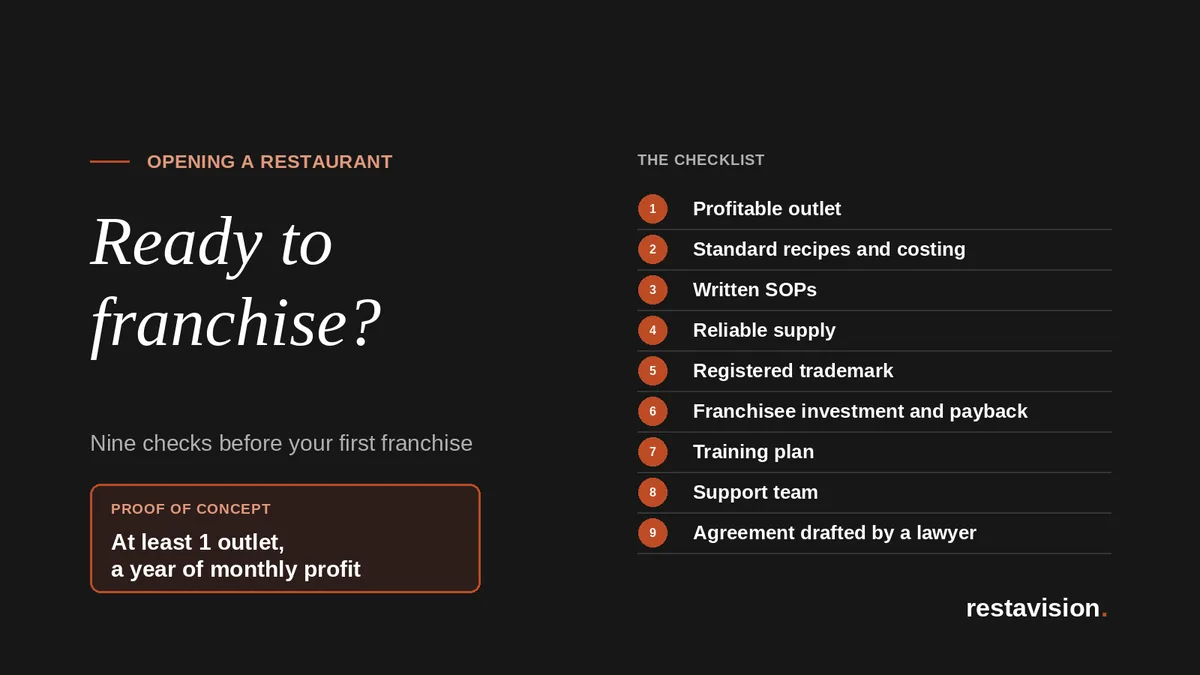
You are ready to franchise when your first outlet is profitable and the way it runs is written down well enough for someone else to repeat. Restavision advises at least one outlet with a year of profit, month after month, before you sell a first franchise. Then work through the nine checks below.
Start with proof of concept
Franchising multiplies what you already have, good or bad. If the first outlet depends on the founder being there every day, changes recipes by the week or only breaks even, copying it copies the problem.
Our advice: at least one outlet, with a year of profit, month after month. A year covers slow months, festive peaks, staff changes and supplier changes. One strong month proves very little.
- Is the outlet profitable every month, after all running costs?
- Do results hold when you are not in the outlet?
- Could a new manager run it from written instructions?
- Do guests come back, and why?
The nine-point checklist
Tick each one honestly. Anything you cannot tick is work to do before you sell.
- The outlet is profitable on its own. It has made a profit month after month for a year, after all running costs.
- Recipes and food costing are standardised. Every dish has a written recipe, portion and cost, so a franchisee’s plate matches yours and their margin is predictable. Our guide to restaurant food cost shows how.
- SOPs are written. Opening, preparation, service, closing, cleaning, receiving and what to do when something goes wrong. See what every restaurant should document.
- Supply is reliable. Key ingredients and packaging can be sourced consistently, with named suppliers and a backup, so every outlet serves the same product.
- The trademark is registered. You are licensing a brand name and logo that you own. Ask your lawyer which registrations you need.
- Franchisee investment and payback are worked out. What a franchisee has to put in, what a typical outlet can earn and how long payback takes, built from your own outlet’s data with the assumptions shown.
- There is a training plan. How a new franchisee and their team learn the system before and after opening, and how you check that they can do it.
- There is a support team. Someone who answers franchisee questions, visits outlets, checks standards and fixes problems, decided before the first franchise is sold.
- A lawyer prepares the agreement. The franchise agreement should be drafted by a lawyer who handles franchise matters. Operating teams supply inputs, but the legal document is a lawyer’s job.
What goes into the franchise manual
The franchise manual is the document a franchisee studies before they commit, and refers to every day after. It should answer the money questions as clearly as the operating ones.
| Section | What it covers |
|---|---|
| Terms and conditions | The franchise terms, as set out with your lawyer. |
| Outlet models | The types of outlet you offer, such as different formats or sizes. |
| Typical investment | What a franchisee typically has to invest to open. |
| Financials | Expected sales, costs and profit, with the assumptions stated. |
| ROI and payback | The expected return on investment and the payback period. |
| Royalty | The royalty a franchisee pays to the franchisor. |
| Sample menu | The core menu, and any variations you allow. |
| SOPs | The operating procedures every outlet follows. |
| Training | The training a franchisee and their team receive. |
| Support | What the franchisor provides after opening. |
| Other clauses | Anything else your lawyer advises. |
We have not put figures here, because investment, royalty and payback depend on your outlet and your model. Build them from your own numbers.
Where Restavision helps
Our franchise service covers six things.
- Readiness assessment: where you stand against the nine checks, and what to fix first.
- Franchisee unit economics: the investment, margins and payback for a franchisee.
- Franchise manual and SOPs: the manual above, with the operating procedures behind it.
- Training system: how franchisees and their teams are trained and checked.
- Franchise agreement, through a lawyer: arranged through a lawyer, with our operating inputs.
- Site selection: a method for judging whether a proposed location suits the format.
Read more on our restaurant franchise consulting page.
Not ready yet? What to fix first
- Profit first. If the outlet is busy but not profitable, start with our guide to where a restaurant’s money leaks.
- Then recipes and costing, so every plate and every margin is the same on every shift.
- Then SOPs and training, so the outlet runs the same way whoever is on duty.
- See where you stand. A restaurant operations audit shows which parts of the business are under control and which are not.
Common questions
How many outlets do I need before I franchise?
Restavision advises at least one outlet with a year of profit, month after month, before you sell a first franchise.
Can I franchise if my outlet is not yet profitable?
We advise against it. A franchisee copies what you have built, so fix profitability first and show a year of steady monthly profit.
What should a franchise manual contain?
The terms and conditions, the financials, the return on investment or payback period, the SOPs, the training and support you provide, and any other clauses your lawyer advises. It should also set out the typical investment, the outlet models you offer, a sample menu and the royalty.
Does Restavision draft the franchise agreement?
The agreement is prepared through a lawyer. Restavision provides the operating inputs and coordinates where that is part of the agreed work.
Do I need a registered trademark before I franchise?
It is one of the nine checks on our list, because you should be licensing a brand you own. Ask your lawyer which registrations you need.
Thinking about franchising?
Tell us about your outlet and what you plan to offer, and we’ll take it from there.
