
A café business plan is not paperwork for a bank. It is the place where you find out, on paper and before you sign anything, whether the café can pay its bills. This guide sets out what to include, the numbers that do most of the work, and a break-even sum you can repeat with your own figures.
The short answer
A café business plan answers four questions: who the café is for, what it costs to open, how much it must sell each day to pay its bills, and how long your money lasts until it does. Seven numbers do most of the work, and they are in the table below.
What the plan is for
- Decisions you cannot easily undo: the lease, the equipment, the size of the team.
- A reality check: if the numbers only work with very optimistic sales, you want to learn that now.
- Other people’s questions: a partner, a lender or an investor will want the same numbers.
What to include
- The concept: what the café is, who it is for and why they would choose it.
- Location and size: the area, the footfall and the space you need.
- Menu and pricing: the items, their costs and their prices.
- Setup budget: every cost to open, with your own quotes.
- Monthly running costs: rent, salaries, power and the rest.
- Sales forecast: bills a day times the average bill, with a realistic ramp-up.
- Break-even: the sales needed to cover all costs.
- Team: who you need, when, and what they will cost.
- Launch plan: soft launch, opening and the first 90 days. See our step-by-step checklist.
- Risks: what could go wrong and what you will do about it.
The numbers that matter
| Number | What it tells you | Where it comes from |
|---|---|---|
| Setup budget | What it costs to open the doors | Quotes for fit-out, equipment, licences and stock. See the café setup cost guide |
| Monthly fixed costs | What you pay whether or not anyone walks in | Rent, salaries, power, software, repairs and the owner’s own pay |
| Average bill | What a typical customer spends | Menu prices and an honest guess at what people will order together |
| Bills a day | How busy the café needs to be | Location, seats, opening hours and the neighbourhood |
| Food and beverage cost % | The share of each sale spent on ingredients and drinks | Costed recipes. See the café menu costing guide |
| Break-even sales | The sales a month at which you stop losing money | Fixed costs divided by what is left of each sale after variable costs |
| Working capital | How many months you can run before sales catch up | Your fixed costs multiplied by the months of ramp-up you want to survive |
A break-even sum you can repeat
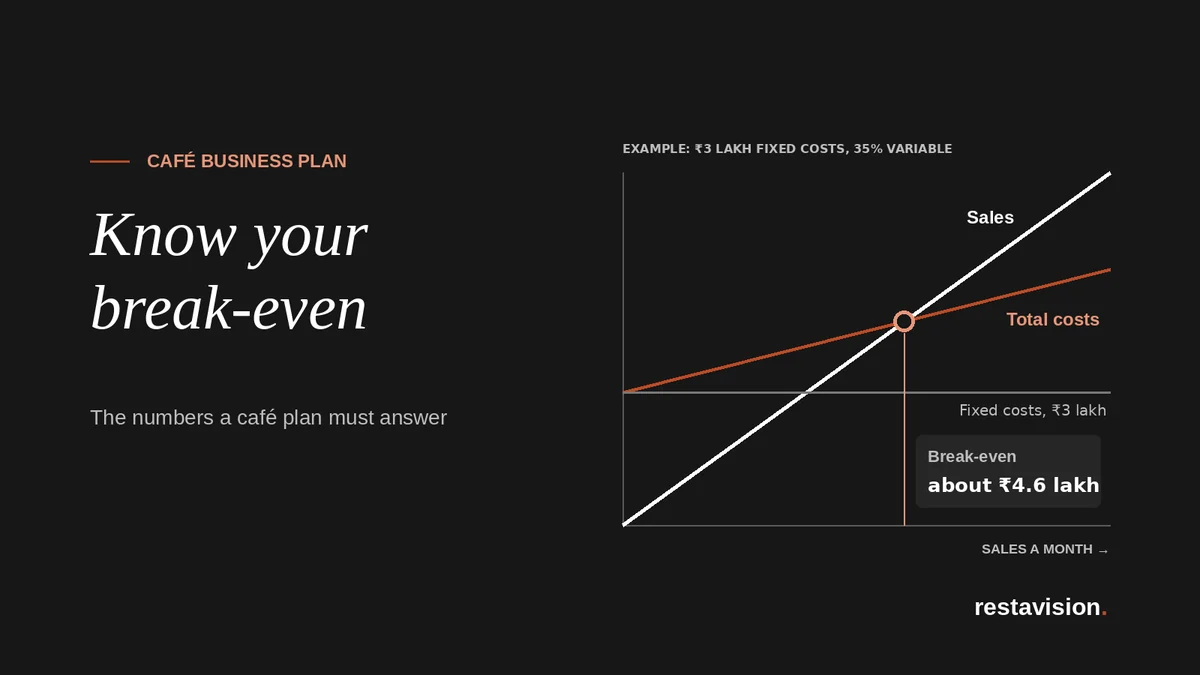
This is an example with example figures, not a forecast for any café. Suppose monthly fixed costs are ₹3 lakh, and variable costs are 35% of sales: 30% food and beverage cost plus 5% for packaging and payment charges. That leaves 65% of each sale to cover fixed costs.
- Break-even sales: ₹3,00,000 ÷ 0.65 = about ₹4.6 lakh a month.
- Per day: about ₹15,400, over a 30-day month.
- In bills: at a ₹250 average bill, about 62 bills a day.
Replace each number with yours. If the bills a day you need are more than the café can seat and serve, change the plan before you change the lease.
Forecast sales as a climb, not a line
A café rarely opens at full sales. In our case study of a first-time founder, the café reached ₹9–10 lakh a month after about 9 to 12 months. Plan the first months at a fraction of your target, and make sure your working capital covers the gap. Our setup cost guide explains why working capital is the line that saves cafés.
Five mistakes in café business plans
- Optimistic sales from day one: a plan that needs full sales in month one is a plan that runs out of money.
- Leaving out the owner’s pay: a café that only works if you earn nothing does not work.
- No working capital: the slow months arrive before the money does.
- Copying someone else’s numbers: their rent, menu and customers are not yours.
- Never looking at it again: the plan is only useful when you compare it with what actually happens.
Common questions
Do I need a business plan to open a café?
You do not need a formal document to open, but you need the numbers in one. Without them you cannot tell whether the lease, the equipment or the menu prices make sense. A bank or an investor, if you use one, will also ask for them.
How long should a café business plan be?
Long enough to hold the numbers and the reasoning behind them. A few focused pages with a costed budget, a monthly cost list, a sales forecast and a break-even sum is more useful than a long document with guesses in it.
What is break-even in a café?
Break-even is the monthly sales at which the café covers all its costs. Divide your monthly fixed costs by the share of each sale left after variable costs such as ingredients, packaging and payment charges.
How should I forecast café sales?
Start low and let sales build. A café rarely opens at full sales. In our case study, a café reached ₹9–10 lakh in monthly sales after about 9 to 12 months.
What do café owners forget to include?
Their own pay, working capital for the slow first months, and the costs that arrive after opening such as repairs, replacement equipment and licence renewals.
How often should I update the plan?
Every month at first. Compare real sales and costs with the plan, find the biggest gaps and change the plan or the café.
Test your café numbers
Share your concept, area and budget, and we’ll tell you which numbers to check before you commit.
