
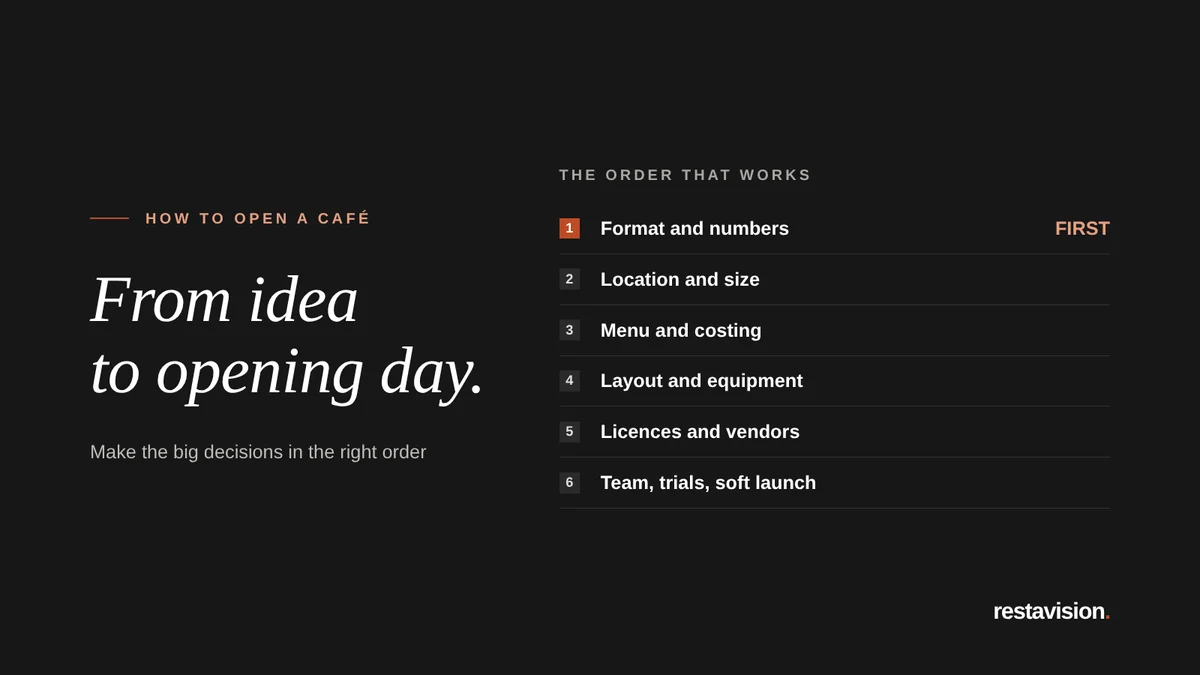
Opening a café looks simple from the guest’s side of the counter: good coffee, a few bakes, a nice room. From the owner’s side it is a few hundred decisions, and the order you make them in matters more than most people expect. Sign the lease before you know the menu, and the kitchen may not fit it. Buy the equipment before you cost the menu, and you may be paying for a machine your prices can’t support. Here is the order we use, from concept to the first 90 days, with a checklist you can work through.
The checklist at a glance
| Stage | When | Done when |
|---|---|---|
| 1. Format and numbers | 6–9 months before | Format, guest, price point, budget and a sales target are written down. |
| 2. Location and size | 5–7 months before | Site checked for footfall, power, water, drainage and rent that fits the numbers. |
| 3. Menu and costing | 4–5 months before | Every item has a recipe, a cost and a price. |
| 4. Layout and equipment | 3–5 months before | Counter, coffee bar and kitchen flow drawn; equipment list priced. |
| 5. Licences | From the day the lease is signed | All approvals needed to trade are applied for, with dates. |
| 6. Vendors | 2–3 months before | Coffee, milk, bakery, packaging and service contacts agreed. |
| 7. Hiring | 6–8 weeks before | Team hired, roles and shifts written down. |
| 8. Training and trials | 2–4 weeks before | Every drink and dish made to standard by every person on the team. |
| 9. Soft launch | 1–2 weeks before | Friends, neighbours and invited guests served; problems fixed. |
| 10. First 90 days | After opening | Sales, cost and feedback reviewed every week. |
The timeline assumes a typical small café. A larger café with a full kitchen, or a site that needs heavy work, takes longer.
1. Choose the format and do the numbers first
Decide what kind of café you are opening before you look at a single property. The format decides the space, the equipment, the team and the money.
| Format | What it needs most | Watch out for |
|---|---|---|
| Coffee-led café | A fast coffee bar, good beans and well-trained baristas. | Low spend per guest. Sales depend on volume and repeat visits. |
| Bakery-café | Production planning, display and a clear plan for unsold stock. | End-of-day wastage that quietly eats the margin. |
| All-day café | A real kitchen and a menu for each part of the day. | Staffing and stock for quiet afternoons. |
| Kiosk | A tight menu, a fast single-person bar and a high-footfall spot. | Rent per square foot, and no seating to hold guests. |
Then write down four numbers: what a guest will spend, how many guests you need a day, what the café will cost to run each month, and how much you can invest. If the numbers don’t work on paper, they won’t work on the street. For a budget by cost head, see how much it costs to open a café.
2. Location and size
A café lives on footfall and repeat visits. Watch the site at the times you plan to be busy: weekday mornings, lunch, evenings and weekends. Count people, not cars.
- Frontage and visibility. Can people see the café, and the coffee bar, from the street?
- Size. Enough room for the counter, the bar, a small kitchen and storage, not just seats.
- Services. Power load for the coffee machine and oven, water supply, drainage and space for exhaust.
- Rent. As a rough guide, rent should stay well under a fifth of the sales you expect.
4. Layout and equipment
Plan the flow before the look. Where does the guest order, pay, wait and collect? Where does the barista stand, and how many steps to the milk fridge, the grinder and the dishwasher? A good layout lets one barista handle the morning rush without crossing paths with the counter staff.
Then prepare an equipment list (a BOQ) sized to your menu and expected cups a day, and get at least two quotes for each major item.
5. Licences and approvals
Start the paperwork as soon as the lease is signed. A food safety licence, shop registration, a trade or eating-house licence from the local authority, fire safety and signage permissions are the usual list. Some take weeks, and you pay rent while you wait. See the licences a food business needs for the full list.
6. Vendors
Agree your coffee roaster, milk, bakery, packaging and equipment service contacts before opening. Ask for samples, compare at least two suppliers for each, and agree delivery days and payment terms in writing. Taste the coffee with your milk, in your cup, on your machine.
7. Hiring and training
Hire six to eight weeks before opening, and start training two to four weeks before. Every barista should be able to make every drink to the recipe, every time. Write down opening and closing routines, cleaning and hygiene tasks, and use simple daily checklists so standards don’t depend on who is on shift.
8. Soft launch
Open quietly first. Serve friends, neighbours and invited guests for a few days, at full speed, with the real menu. Watch the queue, time the drinks, collect feedback and fix what breaks. It is far cheaper to find problems now than in your first online reviews.
9. The first 90 days
Opening day is the start, not the finish. For the first three months, review every week:
- Sales by day and by hour, against your target.
- Food and beverage cost against your menu costing.
- Best and worst sellers, and what gets thrown away.
- Guest feedback and online reviews.
- Staff hours against how busy you actually were.
Most cafés that close early don’t fail on opening day. They fail slowly, in the first months, from small problems nobody measured. See the opening mistakes that sink new food businesses.
Where a consultant helps, and where you can do it yourself
You don’t need help with everything. Be honest about where your experience is thin.
| Usually fine on your own | Where a consultant often pays for itself |
|---|---|
| Name, brand and social media | Checking the site before you sign the lease |
| Choosing the look and furniture | Menu costing and pricing |
| Licence paperwork, with a good agent | Layout, coffee bar and equipment list |
| Hiring support staff | SOPs, checklists and staff training |
| Opening offers and local promotion | The opening plan and the first 90-day review |
If you have run a food business before, you may only need help with one or two steps. Café consulting starts from ₹50,000, depending on the scope of work. For an honest view of when it’s worth it, read do you need a consultant?
Common questions
How long does it take to open a café?
Usually four to nine months from choosing the format to opening day. The site and the approvals decide most of the timeline.
Do I need a business plan?
You need the numbers: budget, monthly running cost, expected guests and average spend. A lender or partner will also want them written up. A long document is optional; the numbers are not.
What is the most common mistake?
Signing the lease and finishing the interiors before the menu and the numbers are settled. It locks in decisions that are expensive to change.
Can I open a café with no food experience?
Yes, many owners do. Hire or train at least one person who knows coffee and one who knows the kitchen, and get help with costing and operations before you open.
We work on-site with café founders in both cities. See our café consultants in Mumbai and café consultants in Pune pages.
Opening a café?
Tell us your café format, where you are in the plan and your target opening date, and we’ll tell you what to do next.
Book a free call