
Most café budgets are built backwards. The owner chooses the interiors they love, adds a coffee machine, and then finds out what is left for everything else. Usually not enough. The café opens beautifully and runs short of cash in month two. A better budget starts from the café you want to run, then works out what each part of it costs. This guide gives planning ranges for a small and a larger café, cost head by cost head, and shows where owners most often get the numbers wrong.
The short answer
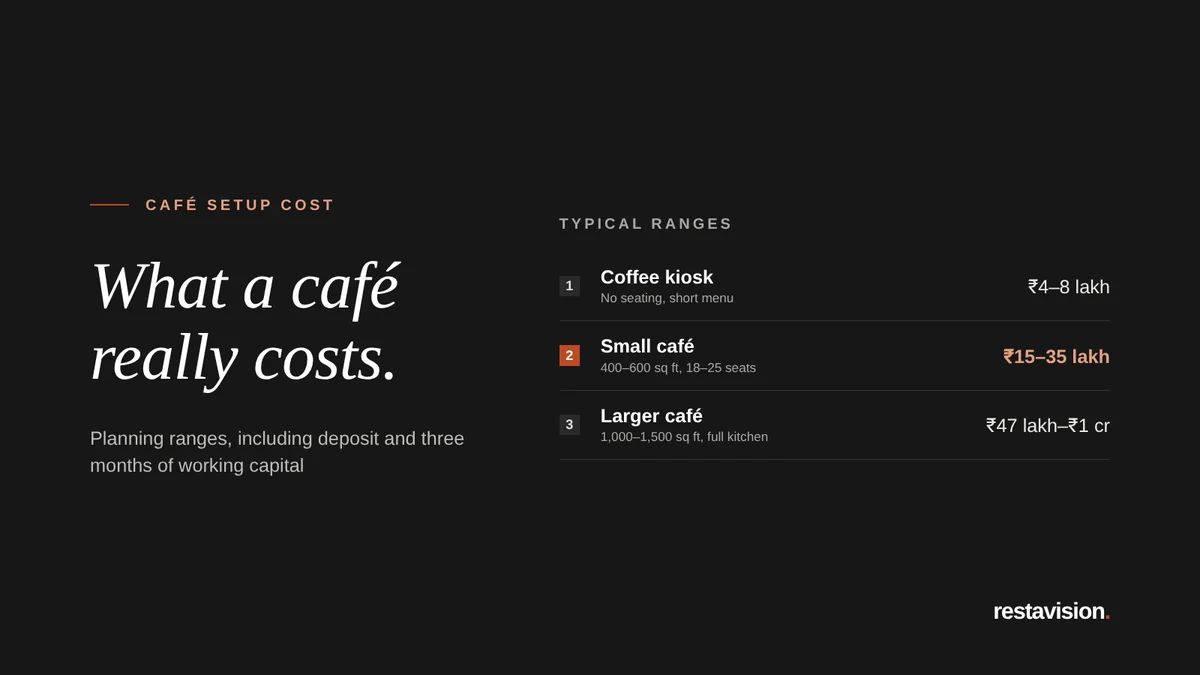
A small café of about 400–600 sq ft with 18–25 seats typically needs about ₹15–35 lakh, including the property deposit and three months of working capital. A larger café of about 1,000–1,500 sq ft with 40–60 seats and a full hot kitchen typically needs about ₹47 lakh to ₹1 crore. A coffee kiosk with a short menu and no seating can start at around ₹4–8 lakh.
Small café: coffee-led menu with bakery and a short food menu, a light kitchen, one espresso machine. Larger café: full food menu with a hot kitchen and a two-group espresso machine. The ranges are planning bands, not quotations. Rent levels, property condition and the finish you choose move them a lot, so replace each line with a real quote before you commit.
Cost head by cost head
Keep each head as a separate line in your budget. It makes vendor quotes easy to compare and shows clearly what can wait until after opening.
| Cost head | Small café | Larger café | What it covers |
|---|---|---|---|
| Property deposit and advance rent | ₹1.5–6 lakh | ₹5–15 lakh | Security deposit, advance rent and brokerage. Usually several months of rent. |
| Fit-out and interiors | ₹4–8 lakh | ₹15–30 lakh | Civil work, electrical, plumbing, flooring, ceiling, lighting, service counter and signage. |
| Coffee equipment | ₹1.5–4 lakh | ₹4–10 lakh | Espresso machine, grinder(s), water filter, blender, milk jugs, scales and tools. |
| Kitchen equipment and refrigeration | ₹1.5–3 lakh | ₹5–10 lakh | Oven, sandwich griller, under-counter fridges, display chiller, ice machine, exhaust and prep tables. |
| Furniture | ₹1–2 lakh | ₹3–6 lakh | Tables, chairs, bar stools and any outdoor seating. |
| Licences and registrations | ₹40,000–1 lakh | ₹1–2.5 lakh | Food safety licence, shop registration, trade or eating-house licence, fire and signage permissions. |
| Technology | ₹30,000–80,000 | ₹80,000–2 lakh | POS, printers, payment devices, CCTV, internet and music. |
| Initial stock and packaging | ₹50,000–1 lakh | ₹1–2 lakh | Coffee, milk, bakery and food ingredients, cups, lids, bags and cleaning supplies. |
| Pre-opening staff and training | ₹80,000–1.5 lakh | ₹2.5–5 lakh | Salaries for the weeks before opening, menu trials and uniforms. |
| Launch marketing | ₹50,000–1.5 lakh | ₹1.5–4 lakh | Menus, photography, social media and opening offers. |
| Working capital (3 months) | ₹3–6 lakh | ₹8–15 lakh | Rent, salaries, utilities and restocking while sales build up. |
| Total (about) | ₹15–35 lakh | ₹47 lakh–₹1 crore | Fit-out to opening day alone: about ₹10–23 lakh (small) and ₹34–72 lakh (larger). |
For the full list of approvals, see the licences a food business needs. For how the same logic works across restaurant formats, see our restaurant setup cost breakdown.
Coffee equipment: size it to your cups, not your ambition
The espresso machine is the most visible purchase in a café, and the easiest to get wrong in both directions. Too small, and the queue builds every morning while the machine recovers. Too big, and you have locked lakhs of rupees into capacity you will not use for years.
| Daily coffee volume | Machine level | Typical price |
|---|---|---|
| About 40–80 cups | Entry commercial machine | ₹1–1.9 lakh |
| About 150–300 cups | Mid-range, usually two groups | ₹1.9–3.2 lakh |
| 500 cups and more | High-volume machine | ₹4–8 lakh |
Three things matter as much as the machine itself:
- The grinder. Commercial grinders range from about ₹30,000 to ₹1.2 lakh. A café that sells a lot of espresso often needs two: one for the house blend and one for decaf or a single origin.
- Water filtration. A filter or softener costs ₹10,000–30,000. Skipping it shows up later as scale, repairs and coffee that tastes different every week.
- Service and spares. Ask who services the machine, how fast they come, and what a gasket or group-head repair costs. A machine nobody nearby can repair is not a bargain.
Some coffee suppliers offer a machine on loan if you buy their beans. It lowers the setup cost, but check the bean price, the minimum monthly order and what happens if you want to change supplier.
What owners usually underestimate
- Working capital. Sales take time to build. Rent and salaries start on day one.
- Electrical load and ventilation. An espresso machine, an oven and air conditioning together often need a power upgrade, and a kitchen needs proper exhaust. Both cost more once the interiors are finished.
- Licence timelines. Every week spent waiting for an approval is a week of rent with no sales.
- Small wares and packaging. Jugs, tampers, trays, containers, cups, lids and bags add up to a surprising amount.
- Pre-opening salaries and training. A team that starts on opening day learns on your first guests.
- Wastage in the first month. Setting the grinder, menu trials and remakes all use stock before a single cup is sold.
Where to save, and where not to
| Safe to save on | Don’t cut corners on |
|---|---|
| Decorative features and feature walls | Espresso machine and grinder sized to your volume |
| Good stock furniture instead of custom pieces | Water filtration, refrigeration and exhaust |
| A big opening event | Electrical load, plumbing and drainage |
| A long menu on day one | A POS that tracks sales and stock item by item |
| Extra equipment “for later” | Staff training and menu trials before opening |
A simple rule: spend first on what the guest tastes and what keeps the café running on a busy morning. Décor can be added once the café is earning.
Working capital: the line that saves cafés
Working capital is the cash that keeps the café open while sales build. Plan for at least three months of fixed running costs, kept separate from the setup budget.
Example for a small café: rent ₹50,000 + salaries ₹90,000 + utilities and other fixed costs ₹30,000 = ₹1.7 lakh a month. Three months = ₹5.1 lakh, set aside before the fit-out starts.
If the budget is tight, cut the fit-out, not this line. A café with simple interiors and three months of cash has time to fix its menu and build regulars. A beautiful café with no cash has to make every decision in a hurry.
Common questions
Can I open a café for ₹10 lakh?
Yes, as a kiosk or a very small café on a modest site with simple interiors and a short menu. Keep three months of working capital inside the ₹10 lakh, not on top of it.
Is it better to rent equipment or buy it?
Buy what the café uses every hour (espresso machine, grinder, refrigeration). A supplier’s loan machine can make sense at the start if the bean contract is fair.
How long does it take to open a café?
Usually four to nine months from choosing the format to opening day, depending on the site and approvals. See how to open a café, step by step.
How do I know the café will make money?
Cost the menu before you buy the kitchen. Our guide to café menu costing shows how to work out what each cup and plate earns.
What does café consulting cost?
Café consulting starts from ₹50,000, depending on the scope of work. A focused job, such as a budget and equipment list, costs less than a full café launch.
We work on-site with café founders in both cities. See our café consultants in Mumbai and café consultants in Pune pages.
Planning a café?
Tell us your café format, size and budget range, and we’ll tell you where the numbers look tight.
Book a free call