
Most restaurants price by looking at the restaurant down the road and picking a similar number. That ignores what each plate really costs to make, so some items quietly lose money while the menu looks sensible. This guide shows a simple way to set a price that covers cost, then check it against the market.
The short answer
Start from the real cost of the item, not from the competition. Divide the real cost by the food cost percentage you can afford to get a starting price, then check it against what guests nearby pay and what the item is worth to them. Round to a clean price and review it regularly.
Four checks for every price
- Real cost. Ingredients, packaging and a wastage allowance. Our menu costing guide shows how to work it out.
- Target food cost. The share of the price you can afford to spend on ingredients. See our food cost control guide.
- Market. What guests already pay for something similar nearby.
- Value. Whether guests will feel the price is fair for the quality, portion and place.
A worked example
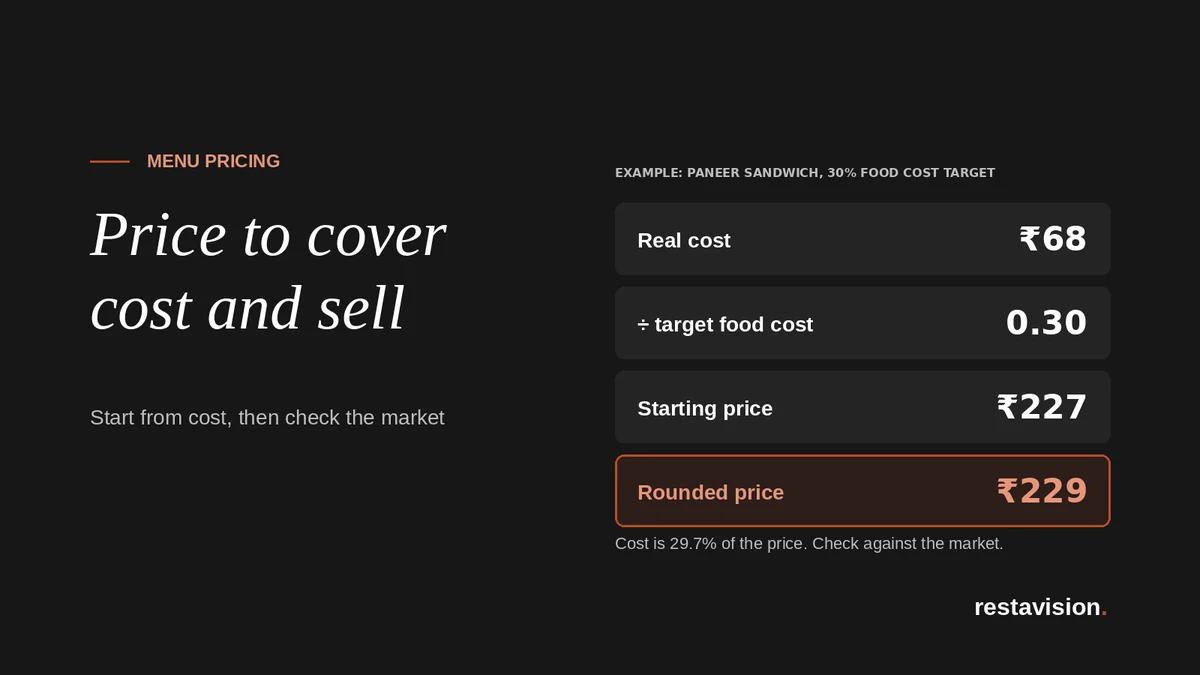
This is an example menu with example costs, not a real restaurant. With a 30% food cost target, the starting price is the real cost divided by 0.30. Then round to a clean price.
| Item | Real cost | Cost ÷ 0.30 | Price chosen | Cost % at that price | Earns per item |
|---|---|---|---|---|---|
| Cappuccino | ₹50 | ₹167 | ₹169 | 29.6% | ₹119 |
| Latte | ₹58 | ₹193 | ₹194 | 29.9% | ₹136 |
| Cold coffee | ₹78 | ₹260 | ₹259 | 30.1% | ₹181 |
| Paneer sandwich | ₹68 | ₹227 | ₹229 | 29.7% | ₹161 |
| Pasta bowl | ₹130 | ₹433 | ₹434 | 30.0% | ₹304 |
The starting price is only a starting point. If the pasta bowl’s starting price is well above what guests will pay, the answer is not to sell it at a loss. Look at the recipe, the portion and the ingredients, or decide whether the item belongs on the menu at all.
Check the market, then decide
- Look at three or four places your guests would otherwise choose, in both price and quality.
- Compare like with like: portion size, ingredients and setting.
- If you are lower than the market, you may be leaving money on the table.
- If you are higher, ask whether the quality and setting justify it.
Make the menu easier to price well
- Use clean price points and keep them consistent across the menu.
- Group similar items so guests compare within a range.
- Price combos from the parts. Make sure the combined price still earns more than the main item alone.
- Test changes on one item and watch sales for a few weeks before changing the rest.
Delivery is a different price
Aggregator commission and packaging reduce what you keep from each order. Many restaurants therefore price delivery items higher than dine-in, or sell a smaller range there. Our guide on aggregator commission and margins shows how to work out what an order really earns.
Review prices regularly
Every month, check your costs against your prices and your sales by item. Our guides on menu engineering and why a busy restaurant is not always profitable show how to find items that sell but do not earn.
Common questions
How do I price a menu item?
Work out the real cost of the item, decide the cost percentage you can afford, divide the cost by that percentage, then check the answer against what guests nearby pay and round to a clean price.
What food cost percentage should I aim for?
It depends on your format, rent and staff costs, so there is no single right number. Our food cost control guide explains how to find yours. The example here uses 30% only to show the method.
Should I match my competitors’ prices?
Use them as a check, not as the answer. If a competitor sells a similar item for less than you can afford, your options are to improve the recipe, change the portion, make the item different, or not compete on that item.
Should I charge more for delivery?
Aggregator commission and packaging reduce what you keep on every order. Many restaurants price delivery separately for that reason. See our guide on aggregator commission.
How often should I change prices?
Review them every few months and whenever ingredient costs move noticeably. Small, regular changes upset guests less than a large jump once a year.
Should I end prices in 9?
It is a common habit, and either approach can work. The important thing is to use one style consistently, and to test it against your own sales.
Price every item with confidence
Share your menu and costs, and we will show you where the money is.
