
A cloud kitchen has no dining room, so it is easy to think it needs almost nothing to start. It does not. It still needs a kitchen, equipment, licences, packaging, a menu that travels well and enough orders every day to pay for all of it. This guide sets out what a first cloud kitchen needs before launch, with planning figures you can test against your own numbers.
The short answer
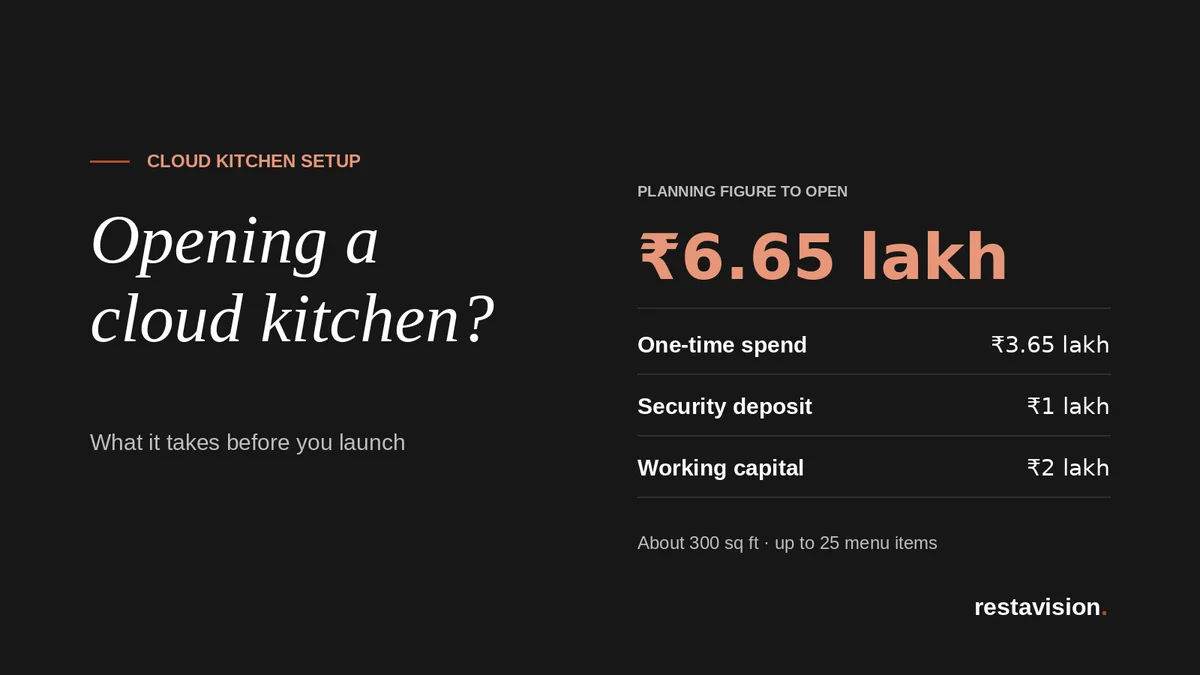
On our planning figures, a first cloud kitchen needs about ₹6.65 lakh to open: ₹3.65 lakh of one-time spend, a ₹1 lakh security deposit and ₹2 lakh of working capital. Rent of ₹30,000 to ₹50,000 a month comes on top. Plan for about 300 sq ft, a menu of no more than 25 items, and a small team at the start.
Where to set up and how big
For a first cloud kitchen we recommend about 300 sq ft, in a densely populated area where both residential and corporate customers are close by. A delivery-only kitchen lives or dies by the number of orders in its delivery radius, so homes and offices together give you dinner orders and lunch orders from the same kitchen.
Rent repeats every month, so settle it before you spend on anything else. Our restaurant setup cost guide shows how rent, deposit and fit-out fit into the wider budget.
What it costs to open
These are planning figures for a first cloud kitchen. Kitchen equipment in particular depends on the menu, so a short menu with fewer cooking methods needs less.
| Cost head | Planning figure | What to know |
|---|---|---|
| Rent (monthly) | ₹30,000 – ₹50,000 | Repeats every month, so choose the area carefully |
| Security deposit | ₹1 lakh | Paid up front when the lease is signed |
| Kitchen equipment | About ₹2 lakh | One-time. It depends on what is on your menu |
| Licences | About ₹50,000 | One-time |
| Technology | About ₹15,000 | One-time |
| Packaging stock | About ₹50,000 | Opening stock |
| Pre-launch marketing | About ₹50,000 | Spent before the first order |
| Working capital | About ₹2 lakh | Runs the kitchen through its first three months |
| Total to open | About ₹6.65 lakh | ₹3.65 lakh one-time, ₹1 lakh deposit and ₹2 lakh working capital |
The working capital line covers the first three months of running the kitchen. At the top of the rent range, three months of rent is ₹1.5 lakh, which leaves about ₹50,000 for everything else. That is why a first cloud kitchen should start with a small team and add people only when orders need them.
Food cost, packaging and order targets
| Target | Planning figure |
|---|---|
| Food cost, first months | 32% – 35% |
| Food cost after 3 months | About 30% |
| Packaging cost | About 5% |
| Orders a day, first 3 months | 60 – 70 (about 2,000 a month) |
| Average order value | At least ₹180 |
Food cost starts higher while recipes settle and purchasing is still new, so we plan for 32% to 35% at first and aim for about 30% after three months of operation. Packaging is a real cost in a delivery-only business, so count it separately at about 5% rather than burying it in overheads.
How many orders a day?
Our planning target for the first three months is 60 to 70 orders a day, about 2,000 a month, at an average order value of at least ₹180. At that average, 1,800 to 2,100 orders is about ₹3.2 to ₹3.8 lakh of sales a month.
Whether that target covers your costs is a separate sum, and you should do it before you rely on it. At ₹180 an order, food cost of 32% to 35% and packaging of 5% leave about ₹108 to ₹113 from every order, or roughly ₹2.2 lakh a month at 2,000 orders. That money has to pay for:
- rent of ₹30,000 to ₹50,000;
- salaries for the team;
- gas, power and water;
- the commission on every order that comes through an aggregator (see what Swiggy and Zomato commission does to your margins);
- marketing and repairs.
Your break-even is the number of orders a day at which what is left after food and packaging covers all of those, and it moves with your average order value and with how many orders come from aggregators. Add up your own monthly running costs first. If they do not fit inside that figure, you need a higher average order value, more orders, or lower costs.
Four mistakes we see most often
- A menu that is too long: more items mean more stock, more waste and less consistency.
- Untrained staff: a delivery-only kitchen has no dining room to hide a bad order in, so every cook needs to follow the same recipe and portion.
- Unreasonable pricing: prices set by guesswork or by copying a neighbour, without costing the dish first.
- Inconsistent food: customers notice when the second order does not taste like the first.
Most of these are fixed before launch rather than after it. A kitchen that opens with a short menu, costed recipes and trained staff has already avoided all four. See also why new restaurants fail and what to check when you are busy but not profitable.
Before you launch: a checklist
- Choose the area: dense, with homes and offices, and rent you can carry.
- Fix the budget: one-time spend, deposit and working capital, using your own quotes.
- Get your licences: start early so they do not delay opening. See the licence guide.
- Plan the equipment around the menu: buy what the 25 items need, not what a full restaurant needs.
- Cost every item and set prices: food cost, packaging and platform commission together.
- Train the team: recipes, portions, packing and the order of work in a small kitchen.
- Stock packaging: food that arrives hot, dry and intact is what customers judge you on.
- Market before opening: the pre-launch budget exists so the first week is not empty.
Common questions
How much does it cost to set up a cloud kitchen?
On our planning figures, about ₹6.65 lakh to open: ₹3.65 lakh in one-time spend (equipment, licences, technology, opening packaging stock and pre-launch marketing), a ₹1 lakh security deposit and ₹2 lakh of working capital. Monthly rent of ₹30,000 to ₹50,000 comes on top, and your own figures will differ with the area and the menu.
How big should a first cloud kitchen be?
Around 300 sq ft is a sensible size for a first kitchen, in a densely populated area that has both homes and offices nearby.
How many items should a cloud kitchen launch with?
No more than 25 items in total, with food and beverages counted together. A shorter menu is easier to cost, cook consistently and train staff on, and you can add items once the first ones are selling.
What food cost should a cloud kitchen aim for?
Around 32% to 35% in the first months, plus about 5% for packaging. After three months of operation, aim to bring food cost down to about 30%.
How many orders a day does a cloud kitchen need?
Our planning target for the first three months is 60 to 70 orders a day, about 2,000 a month, at an average order value of at least ₹180. Whether that covers your costs depends on your rent, staff, how many orders come through aggregators and what they charge, so add up your own running costs before relying on any target.
Do I need a licence for a cloud kitchen?
A cloud kitchen is a food business, so it needs the licences a food business needs. We plan about ₹50,000 for licences, as a one-time figure. Our licence guide lists what to check before you open.
See how much it costs to open a café, with planning ranges for each cost head.
Plan your cloud kitchen with us
Share your menu, area and budget, and we’ll tell you what to check before you commit.
